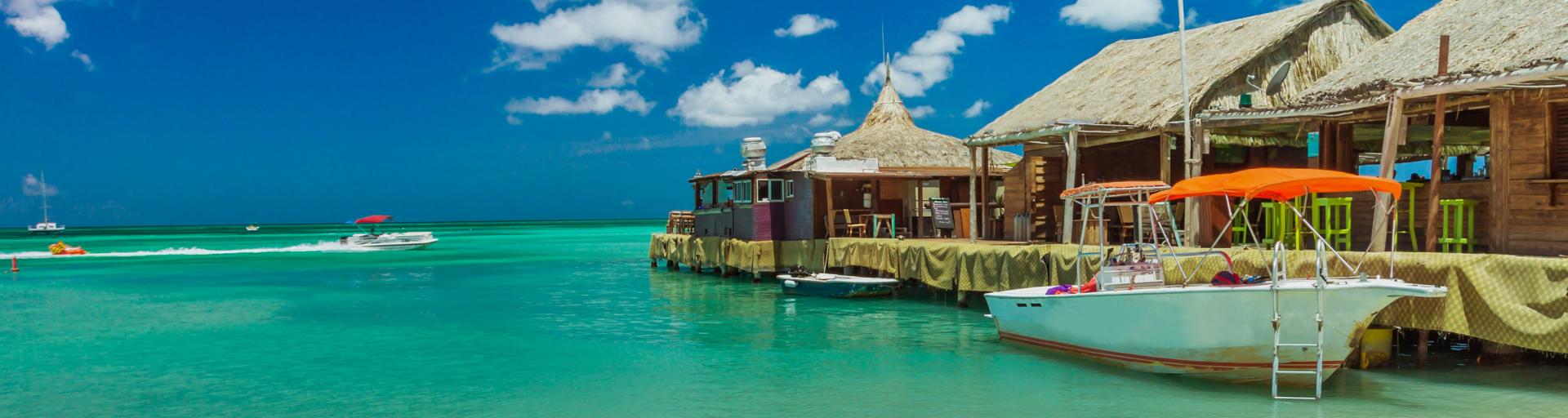
Aruba divides into two halves that bear no resemblance to each other. The southwest coast, sheltered from the trade winds, lines up the white-sand beaches and the entire hotel industry along some fifteen kilometres. The northeast coast, beaten by wind and swell, is a desert of rock, cactus and cliffs where you do not swim. Choosing where to stay here means choosing your distance from the action.
The essentials in four lines
- About five and a half hours non-stop from Montreal to Queen Beatrix airport (AUA), ten to twenty minutes from the hotels.
- Aruba lies outside the hurricane belt: the cyclone season has practically no effect here.
- No significant sargassum on the southwest coast, where all the hotel beaches are.
- One hour ahead of Montreal in winter, same time in summer. US dollars are accepted everywhere.
Where to stay
Palm Beach
The high-rise strip, to the north. Three kilometres of pale sand, flat water, restaurants, shops and a casino within walking distance. It is the liveliest and most convenient sector, the one where you need neither car nor taxi.
Eagle Beach
Just to the south, a far wider and far less built-up beach, lined with small hotels and residences rather than towers. This is where the two wind-bent fofoti trees stand, the island’s emblem. It appears regularly in world rankings, and it stays quiet even in high season.
Oranjestad
The capital, ten minutes away, with its Dutch facades repainted in bright colours, its cruise port, its free tram and its restaurants. Few people stay here; you come for the evening or a morning of sightseeing.
The south
Savaneta and San Nicolas, thirty minutes away, are the Aruba of residents. San Nicolas, the old refinery town, has covered itself in monumental murals since 2016 and hosts an annual street-art festival. Baby Beach, at the southern tip, is a shallow horseshoe lagoon, ideal with young children.
Arikok park
It covers nearly a fifth of the island, on the windward coast. The landscape is volcanic rock, candelabra cactus and divi-divi trees, with caves bearing Arawak drawings, the ruins of nineteenth-century gold mines and a natural pool cut into the lava, where the water stays calm behind a rock barrier while the swell breaks just beyond.
Access requires a four-wheel drive or an organised excursion: the tracks are rocky and impassable in an ordinary car. Allow half a day.
The wind
The trade winds blow over Aruba almost without pause, at fifteen to twenty-five knots. That is what makes the heat bearable despite temperatures around 31 °C year-round, what tilts the divi-divi trees toward the southwest, and what has made Hadicurari, between Palm Beach and the lighthouse, one of the great world gatherings for windsurfing and kiteboarding.
It is also a constraint: badly anchored umbrellas take off, and the sea is livelier than photographs suggest.
In the water
The wreck of the Antilla, a hundred-and-forty-metre German freighter scuttled by her crew in 1940, lies between five and twenty metres off the northwest of the island. It is the largest accessible wreck in the Caribbean and one of the few sites where snorkelling is enough to see the structure.
Elsewhere, the southwest reefs are visited by boat minutes from shore, and catamaran trips combine three snorkelling stops with the sunset.
All-inclusive in Aruba
The format exists but stays in the minority: a few large Palm Beach resorts offer it, often as an option. Most hotels sell by the room, on an island with hundreds of restaurants and a real culture of going out in the evening.
Aruba also sits at the upper end of the Caribbean market: everything is imported and North American demand is strong year-round. Our criteria for choosing an all-inclusive hotel and our file on value for money help place the differences.
When to go
The climate is remarkably stable: around 31 °C year-round, roughly 450 millimetres of annual rainfall, and short showers concentrated between October and January. Aruba lies south of the hurricane belt, which makes it one of the few Caribbean destinations where the cyclone season does not weigh on the decision.
High season runs mid-December to mid-April. May, June and September offer the best rates. Our guide on when to travel south from Montreal sets out the pricing calendar.
To plan this trip, see also our Aruba page and judging value for money.


