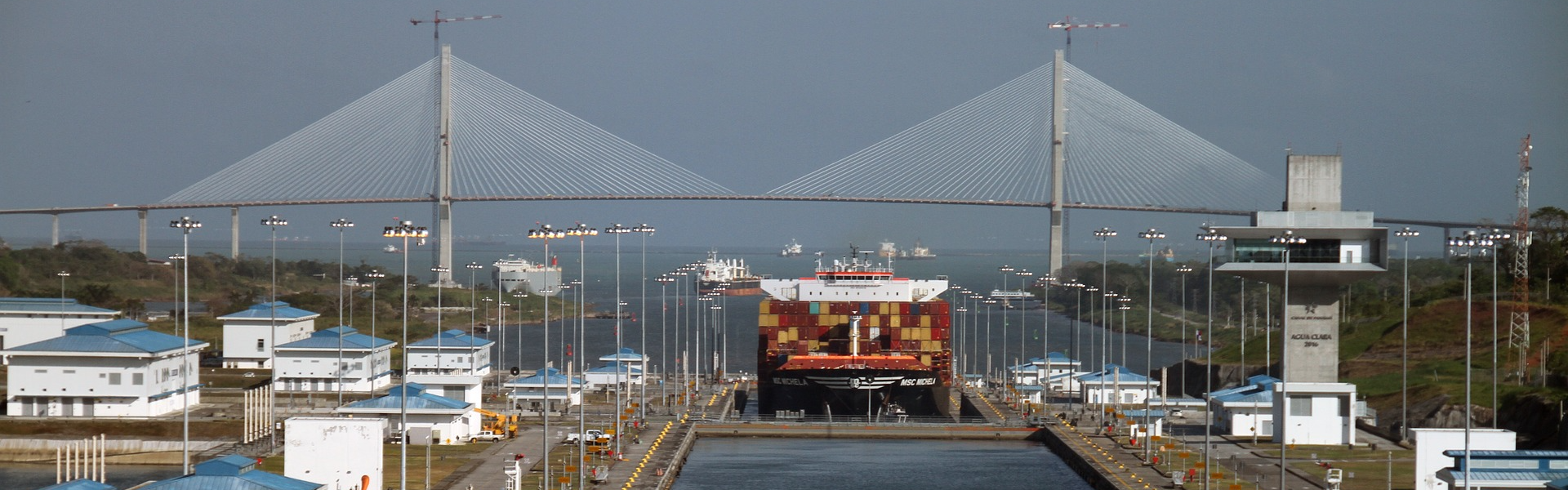
Colón marks the Atlantic entrance to the Panama Canal, eighty kilometres from the capital. The city itself is little visited: it is a port and a free zone, the world’s second largest by volume after Hong Kong. What brings travellers here lies in three things around it: the expanded locks, two Spanish fortresses on the World Heritage list, and an Afro-Caribbean coast that has stayed off to the side.
The essentials in four lines
- About five and a half hours non-stop from Montreal to Panama (PTY), then an hour and a half by road or an hour by train.
- Panama keeps Eastern time all year: same hour as Montreal in winter, one hour behind in summer.
- The city of Colón is not a place for walking around: visits are made on organised excursions or with a driver.
- This is the wettest coast in the country: it rains all year, slightly less from February to April.
The Agua Clara locks
Commissioned in 2016 with the canal expansion, they take the new generation of container ships, three times the volume of those that passed before. The visitor centre overlooks the new locks, the old Gatún locks and the lake at once: the best overall vantage point on how the canal works.
What strikes you most are the water-saving basins beside each chamber, which allow a good share of the fresh water to be reused at every passage. The canal consumes millions of litres per ship, and that question shapes its future.
The transisthmian railway
The line links Panama City to Colón in an hour, following the canal and crossing Gatún Lake on a causeway. It was built between 1850 and 1855, during the California gold rush, long before the canal, and was then the fastest route between the two oceans.
The passenger train runs on weekdays, early in the morning one way and in late afternoon the other, with observation cars. It is the finest way to cross the isthmus.
The fortresses
Portobelo and San Lorenzo have been jointly listed as UNESCO World Heritage since 1980. They guarded the route by which Peruvian silver moved to Spain: galleons came to load at Portobelo during fairs lasting forty days that made the village one of the richest trading points in the world.
What remains are batteries, walls of cut coral, a restored customs house and, at the end of a track, Fort San Lorenzo perched on a cliff at the mouth of the Chagres. Both sites were attacked by Francis Drake, who died off Portobelo in 1596, and later by Henry Morgan.
The coast and Congo culture
Portobelo is also the heart of Congo culture, born among the maroons who took refuge in these forests. Its dance, its drum music and its rites parodying the Spanish colonists have been on the UNESCO intangible heritage list since 2018. The celebrations peak at carnival and on 21 October, the day of the Black Christ, when tens of thousands of pilgrims converge on the village church.
To the east, Isla Grande and Puerto Lindo offer beaches, reef and dive shops in a village setting. That is where the province’s few seafront places to stay are found.
Guna Yala
From this region you can reach the Guna Yala archipelago, more than three hundred islets administered autonomously by the Guna people. Access is by four-wheel drive and then dugout, and accommodation is limited to palm cabins run by the communities. It is an experience apart, to be arranged in advance.
Accommodation
There is no all-inclusive resort in the province. The supply consists of a few business hotels near the free zone, one property on Gatún Lake and small addresses at Portobelo and Isla Grande.
The usual approach is to visit the region on day trips from the capital or from the Pacific coast, where the country’s all-inclusive resorts are. Our criteria for choosing an all-inclusive hotel will apply to that part of the trip.
When to go
Panama’s Caribbean coast receives three thousand millimetres of rain a year, nearly double the Pacific side. February, March and April are the driest months; September and October the wettest.
The country lies outside the hurricane track. Our guide on when to travel south from Montreal sets out the pricing calendar.
To plan this trip, see also our Panama page, Panama City, Playa Blanca and resorts that suit families.


