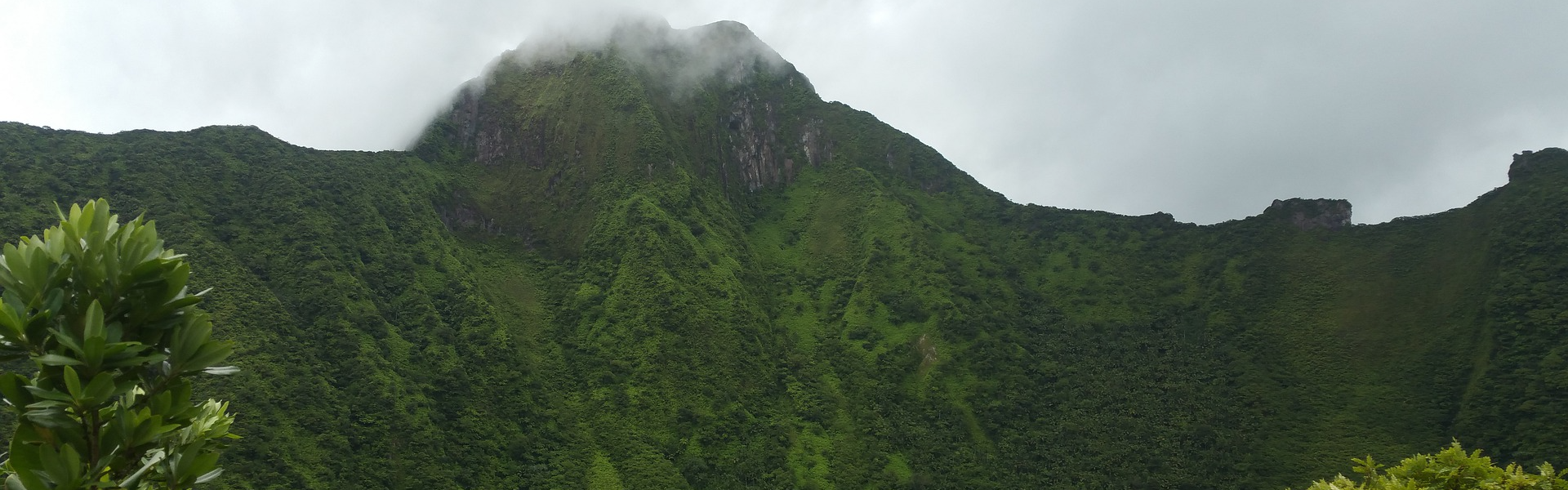
Nevis covers ninety-three square kilometres and has eleven thousand residents. It is an almost perfect volcanic cone, topping out at nine hundred and eighty-five metres and capped in cloud most of the time, ringed by a single road that circles it in forty minutes. There is not one traffic light on the island.
The essentials in four lines
- You arrive through Saint Kitts: fly into Robert L. Bradshaw (SKB), then forty-five minutes by ferry or ten minutes by launch from the southern peninsula.
- Driving is on the left and a temporary local permit is required, in addition to your Quebec licence.
- East Caribbean dollar, US dollars accepted. One hour ahead of Montreal in winter.
- December to April is the dry season. Hurricane season from early June to late November.
Pinney’s Beach
Six kilometres of pale sand lined with coconut palms, on the leeward coast facing Saint Kitts. It is the island’s main beach and practically the only one with services: a few hotels, two or three shacks serving grilled fish and rum punch, and generally calm water.
The rest of the shoreline alternates small grey-sand coves and rocky coast. Oualie Beach, to the north, is shorter and home to the dive shop; Lovers Beach, further north still, is empty on weekdays.
An island of history
Alexander Hamilton’s birthplace
He was born in Charlestown in 1755, the illegitimate son of a Scottish merchant, and left the island at seventeen never to return. The rebuilt house holds a small museum and the seat of the local assembly. It is a thirty-minute detour that puts the role of these islands in the eighteenth-century Atlantic economy in perspective.
The Bath hot springs
A spring rises at forty-five degrees at the foot of the volcano. An establishment built in 1778 to receive visitors from Europe is regarded as the first hotel in the Caribbean. The building now houses government offices, but the stone pools below remain accessible and are used by Nevisians at the end of the day.
What the sugar left
Dozens of stone mill towers punctuate the island, remnants of the plantations. Several have been built into hotels or private houses; others stand alone in the fields.
The volcano and the trails
Nevis Peak is climbed in four to five hours round trip, with a mandatory guide: the last section is done on ropes, in mud, and the summit is almost always in cloud. It is not a courtesy hike.
More accessible, the Source Trail follows an old water pipeline along the mountainside through rainforest, with green monkeys, hummingbirds and views over the sea. Allow two hours.
Accommodation
There is no large all-inclusive resort on Nevis. The supply consists of plantations converted into characterful hotels in the heights, one larger beachfront property on Pinney’s Beach, and a handful of small addresses and villas.
Meals are taken in the island’s restaurants, several of them in former great houses. If all-inclusive is your main criterion, Saint Kitts or other islands will suit better; our criteria for choosing an all-inclusive hotel help compare.
Who it suits
Nevis rewards the traveller who comes for quiet, walking and history, and who accepts that nothing happens after nine in the evening. There is no nightlife, no shopping centre and no excursion beyond the volcano, the diving and the island loop.
The combination that works best: a few nights here after a week on Saint Kitts, or the reverse. The ferry makes the round trip simple, and the two islands do not share a rhythm at all.
When to go
From December to April the air stays around 28 °C, the trade winds blow and rain is rare. From July to October, heat and humidity climb and the cyclone season peaks.
Culturama, the island’s cultural festival, is held in late July and early August. Our guide on when to travel south from Montreal sets out the pricing calendar.
To plan this trip, see also our St Kitts page, St kitts and judging value for money.


