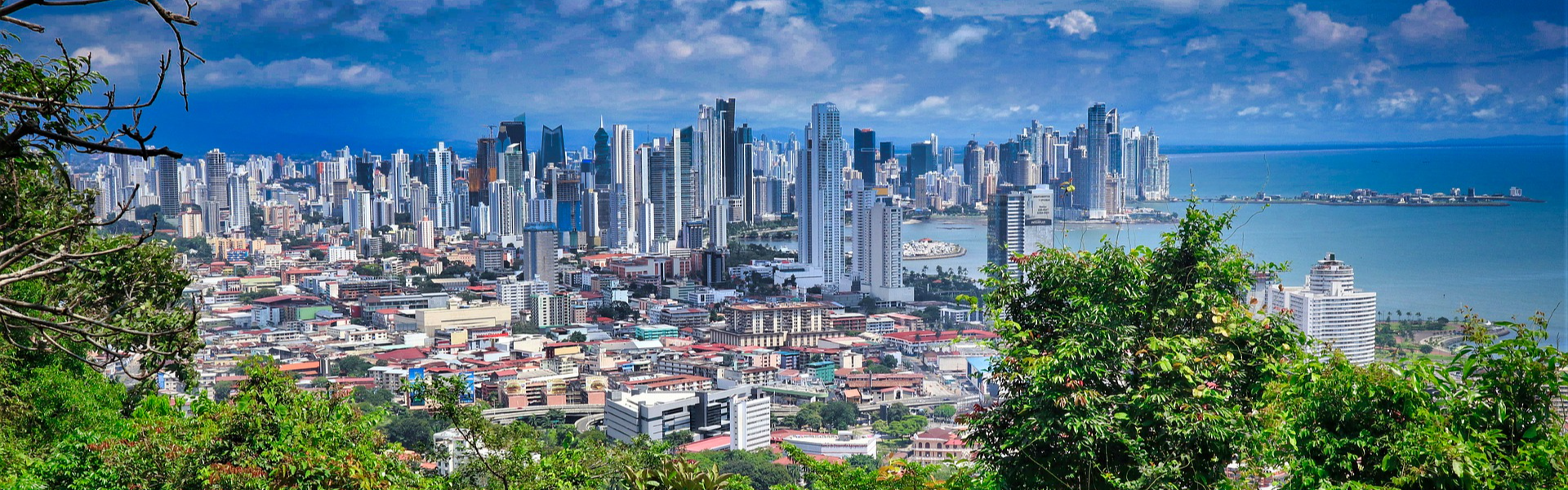
Panama City is the only Latin American capital where you can see primary rainforest from the foot of the office towers. The city sits on a point between the Pacific and the entrance to the canal, with three layers visible side by side: the ruins of the city founded in 1519, the colonial quarter rebuilt after 1673, and a skyline raised in thirty years.
The essentials in four lines
- About five and a half hours non-stop from Montreal to Tocumen airport (PTY), thirty to forty minutes from the centre.
- Panama keeps Eastern time all year: same hour as Montreal in winter, one hour behind in summer.
- The US dollar is the circulating currency, called the balboa locally for the coins.
- This is not a beach city: the Pacific beaches are an hour and fifteen minutes west by road.
The canal
The Miraflores locks, twenty minutes from the centre, are the simplest place to understand how the thing works: an observation deck overlooks the chambers, a museum explains the construction, and ships pass metres in front of you.
Check the transit schedule before setting out, as it varies from day to day: without a ship the visit loses most of its point. Mornings are generally best.
To go further, you can cross part of the canal on a half-day partial transit, or see the expanded locks commissioned in 2016 on the Atlantic side, which take the largest container ships.
Casco Viejo
The colonial quarter was built in 1673 after the destruction of the first city. A UNESCO World Heritage site, it has been restored since the 2000s: wrought-iron balconies, ochre and blue facades, shaded squares, the ruins of the Jesuit church left open to the sky.
It is now the district of restaurants, rooftops and small characterful hotels. The seafront promenade at the end of the point gives the country’s most photographed view: colonial balconies in the foreground, skyscrapers behind.
Panamá Viejo
East of the city, the ruins of the settlement founded in 1519, the first European city on the Pacific coast of the Americas. It was destroyed in 1671 in the attack by the privateer Henry Morgan and never rebuilt: what remains is the cathedral tower, sections of wall and a street plan, in the middle of a park. Allow ninety minutes with the museum.
Forest inside the city
The metropolitan natural park protects two hundred and thirty hectares of rainforest within the city limits. Four trails, one of which climbs in thirty minutes to a lookout over the canal, the bay and the towers. Sloths, toucans, agoutis and titi monkeys are seen early in the morning.
The Amador causeway, built from the spoil dug out of the canal, links four islets to the mainland over six kilometres. You ride it by bicycle, the city on one side and the canal entrance on the other. At its start stands a biodiversity museum with brightly coloured metal roofs, designed by Frank Gehry.
The beaches, nearby
The city has no usable beach. Three options depending on your time: the Pacific coast an hour and fifteen west, where the country’s large all-inclusive resorts are; the Pearl Islands, twenty minutes by air, with their pale sand beaches; and the Guna Yala archipelago on the Caribbean side, two and a half hours by road then by dugout, where Guna communities run the visitor arrangements themselves on tiny islets.
At the table
The fish market, at the edge of Casco Viejo, serves ceviche at the counter in plastic cups for a few dollars. It is the simplest and most memorable food experience in the city.
Elsewhere, sancocho de gallina, a hen soup with culantro, and patacón, smashed fried plantain, accompany nearly everything. And to settle a stubborn misunderstanding: the Panama hat is Ecuadorian.
Accommodation
There is no all-inclusive resort in Panama City itself: the supply consists of business hotels in the tower districts and small characterful addresses in Casco Viejo. For the beach portion you have to move to the coast.
The usual approach is to combine two or three nights in the city with a week on the Pacific coast. Our criteria for choosing an all-inclusive hotel will apply to that second part.
When to go
The dry season runs mid-December to mid-April: clear skies, trade winds, more bearable humidity. That is the high season.
From May to November, showers fall in the late afternoon, generally for an hour or two, and the vegetation is at its densest. The country lies outside the hurricane track. Our guide on when to travel south from Montreal sets out the pricing calendar.
To plan this trip, see also our Panama page, Colon, Gamboa and our month-by-month calendar.


