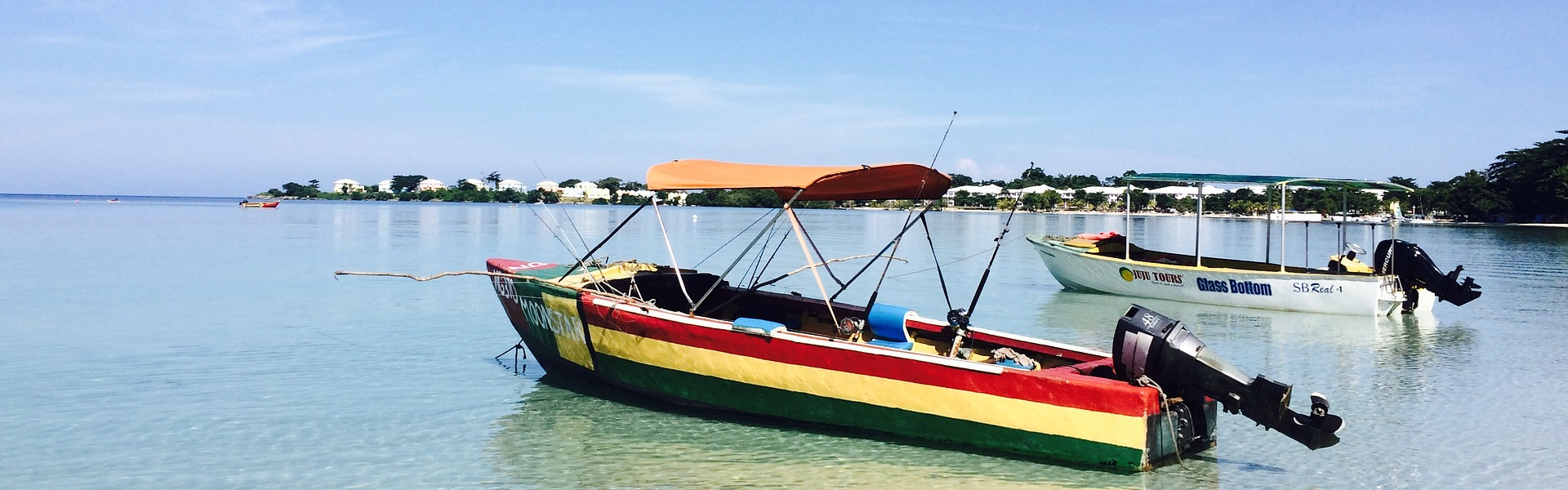

Negril occupies the western tip of Jamaica, an hour and a half by road from Montego Bay airport. The town divides into two halves that bear no resemblance to each other: to the north, a long white-sand beach lined with hotels; to the south, black limestone cliffs where you dive straight into thirty metres of water. Between them, a roundabout and a petrol station.
The essentials in four lines
- About four and a quarter hours non-stop from Montreal to Montego Bay (MBJ), then a ninety-minute transfer.
- Jamaica stays on Eastern time all year: same hour as Montreal in winter, one hour behind in summer.
- The west coast is largely spared by sargassum.
- December to April is the dry season. Hurricane season runs June to November.
The beach
It is called Seven Mile Beach, though it measures a little over six kilometres. It remains the longest continuous beach in Jamaica: fine white sand, a very gentle slope, calm shallow water for tens of metres, and no reef in the way of swimming. It faces due west, which explains the sunsets the whole town treats as a daily ritual.
Two honest reservations. The beach has suffered significant erosion over twenty years, and its width varies a great deal from hotel to hotel: some properties have lost much of their sand, others have not. That is the first thing to check before booking. Second, the public stretch draws persistent vendor attention; it is the flip side of a local economy that depends directly on tourism, and a polite, friendly refusal generally settles it.
The West End cliffs
South of the roundabout, the road follows a limestone cliff riddled with sea caves. There is no beach: hotels reach the water by stairways, ladders and platforms cut into the rock, and the sea is immediately deep and very clear.
This is the sector of small characterful hotels, perched restaurants and cliff jumping. The best-known jump is from a ten-metre terrace that has been an institution since the 1970s, where people come above all for the sunset and the live music.
At the end of the road, Negril lighthouse marks the westernmost point of the island.
What lies around
Booby Cay, ten minutes by boat from the north end of the beach, serves as a stop on snorkelling excursions. Glass-bottom boats leave the hotel stretch throughout the day.
Behind the beach lies a vast wetland, the Great Morass, the island’s second largest. A reserve with wooden walkways allows you to watch herons, kingfishers and a hundred or so bird species, best at first light.
Further away, Mayfield Falls, an hour inland, are climbed on foot through the water between pools and cascades. It is the less crowded alternative to the famous falls at Ocho Rios.
All-inclusive in Negril
The supply is concentrated almost entirely on the beach, with family resorts, several couples-only properties and a few mid-size addresses at more accessible rates. The West End works the other way, with small hotels sold without meals.
Negril has a reputation for a relaxed atmosphere that still holds: fewer large complexes than Montego Bay, more beach bars, more live music. If you want beach and quiet, it is a good choice; if you want varied excursions at short distance, Ocho Rios or Montego Bay suit better, if only because of transfer time. Our criteria for choosing an all-inclusive hotel cover the rest.
When to go
From December to April the air holds around 29 °C, the trade winds blow and rain is brief. This is high season, with price peaks over the holidays and March break.
May, June and the first half of December offer the best balance of weather and price. From August to October, heat and humidity climb and the cyclone season peaks. Our guide on when to travel south from Montreal sets out those cycles.
To plan this trip, see also our Jamaïque page, South Coast, Kingston and judging value for money.


