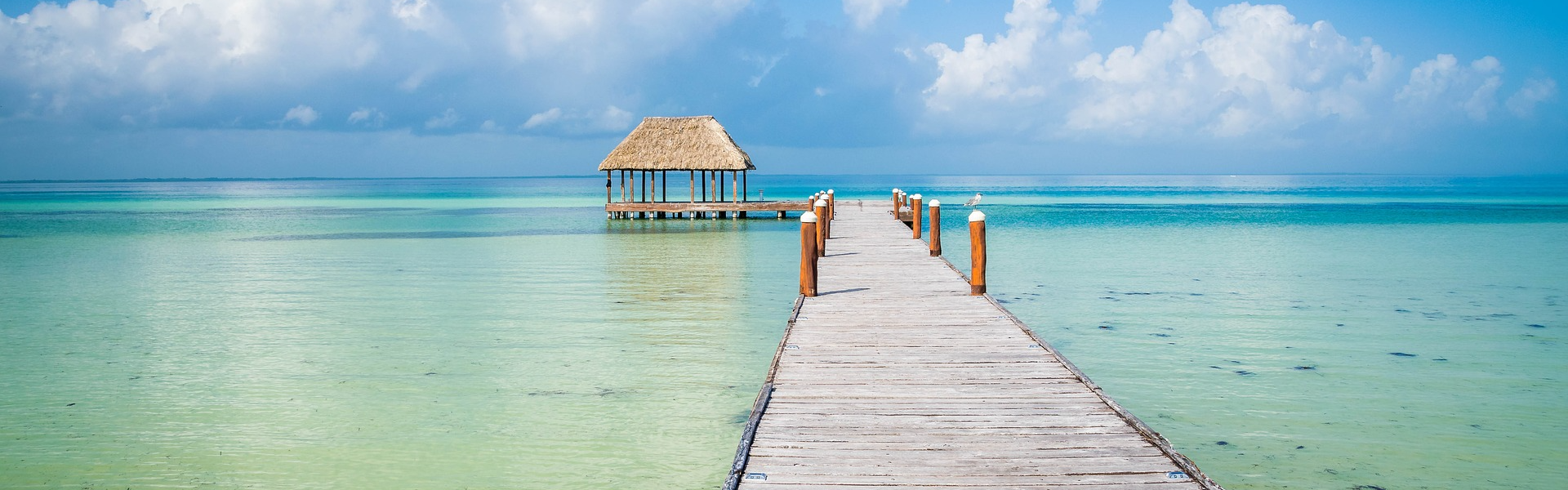
Holbox is a sand island forty kilometres long and two wide, separated from the northern Yucatán by a lagoon. There is no paved road, no car, no large resort. You move by electric cart or on foot along sand streets, and the water, very shallow, stays milky and warm for hundreds of metres. It is the exact opposite of Cancún, three hours away.
The essentials in four lines
- Two to two and a half hours by road from Cancún airport to the port of Chiquilá, then a thirty-minute ferry.
- No cars on the island. Electric carts, bicycles and walking.
- The island faces the Gulf of Mexico and receives very little sargassum compared with the east coast.
- Whale sharks from June to September. Bioluminescence from July to January.
Getting there
The journey is part of the experience and deserves planning. From Cancún you drive two and a quarter hours to the village of Chiquilá, by shared shuttle, bus or private car. You leave the vehicle in a guarded lot, and the ferry takes half an hour.
Departures thin out in the evening: plan to reach Chiquilá before late afternoon. On the island, hotels send a cart to the pier if you let them know.
What people come to see
Whale sharks
From June to September, the largest fish in the world gathers by the hundred off the northern tip of the peninsula to feed on plankton. Trips leave early, run five to six hours and operate in small supervised groups: two swimmers in the water at a time, with a guide, no contact and no chemical sunscreen. It is the main reason to come in that season.
Bioluminescence
From July to January, luminous plankton makes the water glitter at the slightest movement on moonless nights. It is watched from the northern and eastern beaches, away from village lights. The display depends on tide, wind and moon phase: ask locally rather than booking it in advance.
The birds
The island is part of a biosphere reserve protecting the mangrove and lagoons. Flamingos, pelicans, frigatebirds and spoonbills are seen year-round, peaking between April and October. Bird Island is visited by skiff, without landing.
The beaches
Punta Cocos, to the west, has the calmest water and the best sunsets. Punta Mosquito, to the east, reveals at low tide a vast sandbar where you walk far from shore in calf-deep water. Between them, the village beach lines up a few restaurants and hammocks strung in the shallows.
A word of honesty: Holbox does not have the hard turquoise of the Caribbean Sea. The water, very shallow and sediment-laden, tends toward milky green. It is beautiful in another way, but it is not the Tulum postcard.
Life on the island
The village fits into a dozen sand streets around a central square. Fish restaurants, taquerías, murals painted on the facades, a school, a church. In the evening everything is done on foot and the lighting stays modest.
Two practical points. ATMs are scarce and go out of service: bring enough pesos. And mosquitoes are present from dusk, above all from June to November; effective repellent is not optional.
Accommodation
There is no all-inclusive resort on Holbox, and there probably never will be: reserve rules limit building height and footprint. The supply consists of hotels of twenty to sixty rooms, often built in wood and palm, plus a few more polished beachfront addresses.
Many travellers combine three or four nights on Holbox with a week of all-inclusive in Cancún or the Riviera Maya: probably the best way to approach the island. Our criteria for choosing an all-inclusive hotel will help with the beach portion of the trip.
When to go
From December to April the weather is dry, the air holds around 28 °C and mosquitoes are scarce: the most comfortable period, but without whale sharks.
From June to September, heat and humidity climb, showers become daily and mosquitoes are active, but it is the season of whale sharks and bioluminescence. Our guide on when to travel south from Montreal places those windows in the departure calendar.
To plan this trip, see also our Mexique page, Riviera Maya, Riviera Nayarit and the sargassum picture.


