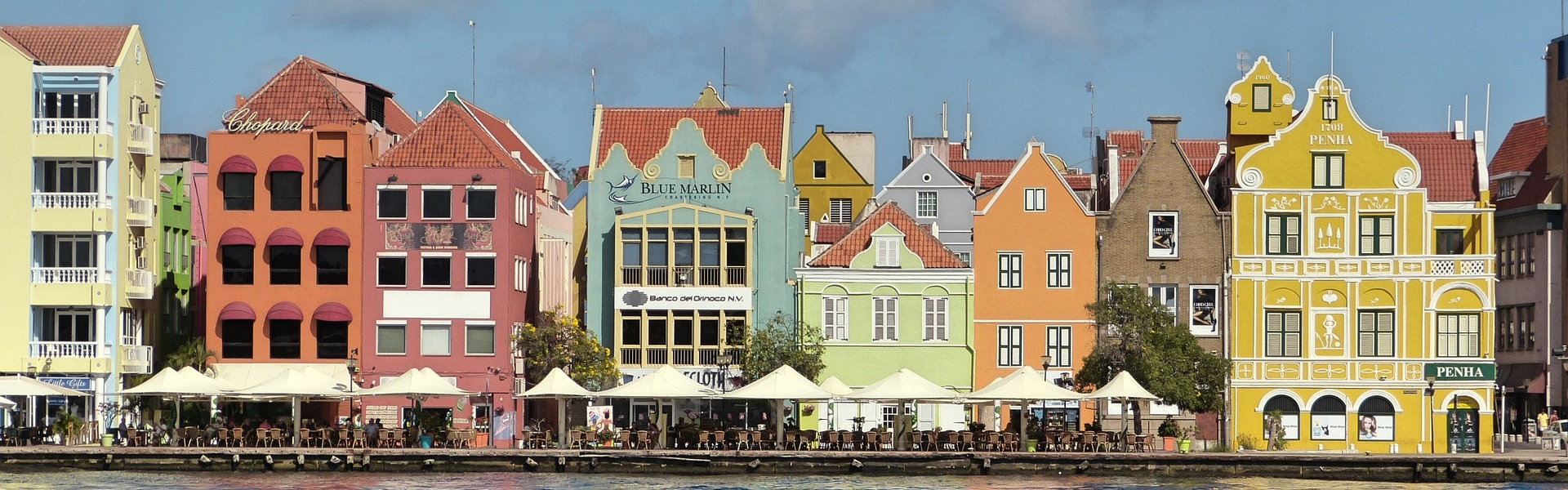
Curaçao is not visited like a single-beach island. Its capital, Willemstad, is a UNESCO World Heritage site occupying both banks of a shipping channel. Its beaches, some thirty of them, are small coves set between limestone cliffs along the whole southwest coast, each with its reef metres from shore. You rent a car and change beach every day.
The essentials in four lines
- About five and a half hours from Montreal to Hato airport (CUR), with seasonal non-stop service.
- Curaçao lies outside the hurricane belt and is practically spared by sargassum.
- The Antillean guilder is the official currency, but US dollars circulate everywhere. Dutch, Papiamentu, English and Spanish are spoken.
- One hour ahead of Montreal in winter, same time in summer. Dry climate year-round.
Willemstad
Punda and Otrobanda
The two banks of the Sint Anna channel, linked by a floating pontoon bridge that swings aside several times a day to let ships through. Pedestrians step off and wait, or take the free ferry: it is the city’s daily spectacle.
Punda lines up the facades that made the island’s name, those eighteenth-century Dutch merchant houses painted ochre, turquoise and pink. Local legend has it that a governor banned white in 1817 because the glare gave him migraines. Punda also holds the oldest synagogue in continuous use in the Americas, founded in 1651, its floor covered in sand.
Pietermaai and Scharloo
Two neighbouring districts long left derelict and restored over the past twenty years. Pietermaai now holds the restaurants, bars and small characterful hotels; Scharloo lines up nineteenth-century merchant houses and monumental murals.
The beaches
They follow one another along the southwest coast, between Willemstad and the western point, and all are reached by car.
Cas Abao and Playa Porto Marie are the most developed, with loungers, a restaurant and a dive shop. Grote Knip and Kleine Knip, further west, are two pale-sand coves set into the rock, spectacular and free. Playa Lagun is tiny but holds green turtles metres from shore.
The Blue Room, near Santa Cruz, is a sea cave entered by snorkelling: light passing through the submerged opening saturates the water an electric blue for two hours around midday.
Near town, Mambo Beach and the Sea Aquarium area are the simplest option for anyone without a car.
Shore diving
This is Curaçao’s particularity: the reef starts five or ten metres from the shore and the wall at about thirty. So you dive from the beach, without a boat, at some forty marked sites.
The best known is a small tugboat sunk in five metres of water in a southern bay, entirely covered in coral and reachable by snorkel. Further north, a field of mushroom-shaped coral heads spreads over several hundred metres.
The north and the interior
Christoffel national park, forty-five minutes away, covers the northwest end: dry forest, cactus, white-tailed deer introduced centuries ago, and a three-hundred-and-seventy-two-metre summit climbed in ninety minutes. Go early; there is no shade at all.
Shete Boka, right beside it, protects ten inlets on the windward coast where the Atlantic swell rushes into caves and erupts through blowholes. Turtles nest there between May and November.
The Hato caves, near the airport, are visited with a guide: stalactites, pools and Arawak drawings centuries old.
Accommodation
All-inclusive exists at a few large properties in the Sea Aquarium area and on the west coast, but it remains a minority. Most of the supply consists of mid-size hotels, residences and small addresses in Pietermaai, sold by the room.
That fits the island: Curaçao is covered by car and eaten in its restaurants. If you prefer to stay at the resort, check the quality of the beach in front of the hotel first, because they are not all equal. Our criteria for choosing an all-inclusive hotel set out what to look at.
When to go
The climate is dry and stable: around 31 °C year-round, roughly 550 millimetres of rain concentrated from October to January in short showers. The island lies south of the hurricane belt.
High season runs mid-December to mid-April. May, June and September offer the best rates. Carnival, from January into February, lasts several weeks and peaks with a large night parade. Our guide on when to travel south from Montreal sets out the calendar.
To plan this trip, see also our Curaçao page and our month-by-month calendar.


