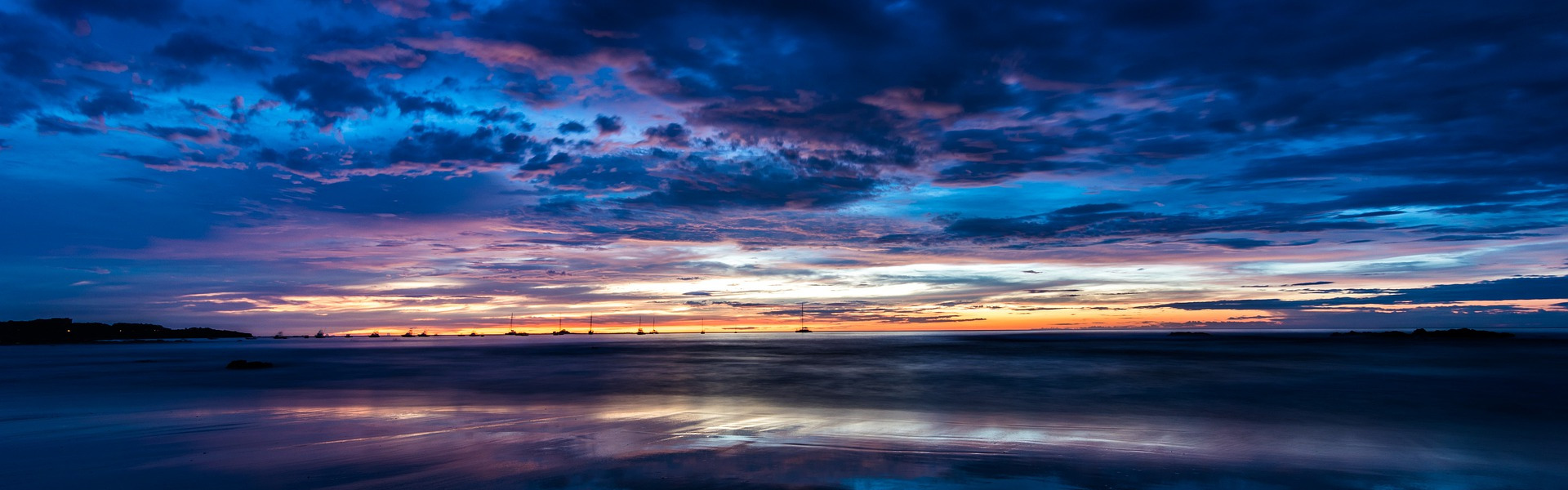
Tamarindo is Costa Rica’s best-known surf village. One main street, a bay open to the Pacific, a river mouth lined with mangrove, and a long, soft wave that breaks far enough out for beginners to stand up in their first lesson. The rest of the village was built around that: schools, board shops, restaurants, bars and a rhythm unlike any conventional beach resort.
The essentials in four lines
- About five and a half hours non-stop from Montreal to Liberia (LIR), then an hour by road.
- Costa Rica runs one hour behind Montreal in winter and two in summer.
- No sargassum: the coast faces the Pacific. The sand is golden to light grey.
- December to April is the dry season. Green season from May to November.
The beach and the surf
Tamarindo bay runs nearly two kilometres, with a gentle slope and several peaks depending on the tide. The wave in the middle of the bay is the schools’ wave: soft, long, easy to read. The peaks near the river mouth and toward the rock to the north suit experienced surfers better.
One safety point worth repeating: the current at the river mouth, at the south end of the beach, is strong and permanent. You do not swim there, you do not swim across it, and there are crocodiles in the estuary. The crossing to Playa Grande is made by boat, for a few dollars.
Swell is present year-round. From December to April the waves are smaller and offshore wind holds them well; from May to October, southern swell builds and conditions become more demanding.
Around
Playa Grande and the turtles
Across the estuary, a four-kilometre beach almost without buildings, protected by a national park. Leatherback turtles nest there from October to February. Their numbers have fallen dramatically since the 1990s and viewing is strictly controlled: night outing with a licensed guide, limited groups, no lights. It is not guaranteed, and that is precisely what makes it a serious experience.
The estuary
A ninety-minute skiff trip through the mangrove at sunrise or sunset: crocodiles, howler monkeys, iguanas, herons and kingfishers. It is the simplest excursion in the area and one of the best value.
The other beaches
Playa Langosta, ten minutes south, is shorter and far quieter. Playa Conchal, twenty minutes north, takes its name from the crushed shells that replace sand and offers the most turquoise water in the region. Playa Avellanas and Playa Negra, thirty to forty minutes south, draw experienced surfers.
The village
Tamarindo is international, lively and expensive by Costa Rican standards. It has good restaurants, cafés, real nightlife and a substantial foreign resident population. Anyone looking for an authentic fishing village will be disappointed; anyone who wants to learn to surf, go out in the evening and have everything within walking distance will be well served.
For a quieter stay, Sámara or Playa Hermosa in Guanacaste suit better.
Accommodation
The supply consists mainly of mid-size hotels, condos and rentals sold without meals, with one or two addresses offering an optional all-inclusive plan. The region’s large all-inclusive resorts are found rather toward Conchal and the Papagayo peninsula, twenty to forty minutes away.
Since the village has dozens of restaurants within walking distance, room-only makes sense here. Our criteria for choosing an all-inclusive hotel help do the maths for the way you travel.
When to go
From December to April the sky stays clear, the air holds around 33 °C by day and rain is practically absent. The landscape is then dry and dusty, the forest having shed its leaves.
From May to November, late-day showers green everything again, the swell builds and prices fall. September and October are the wettest months. Our guide on when to travel south from Montreal sets out the pricing calendar.
To plan this trip, see also our Costa Rica page, Samara, San José and resorts that suit families.


