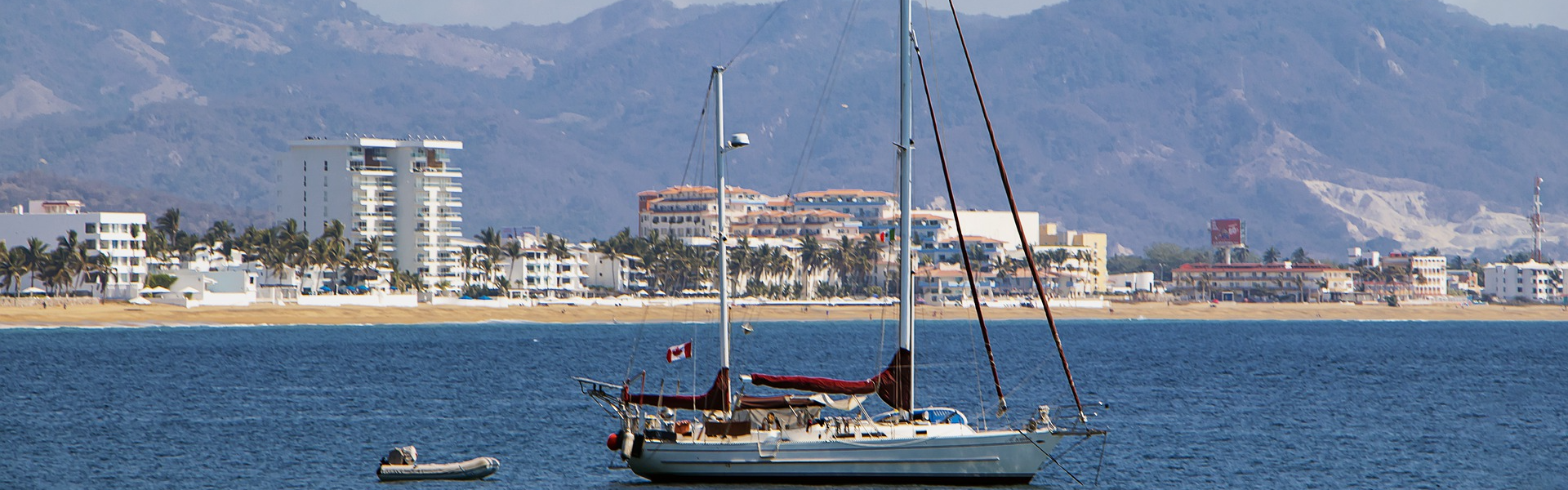
Manzanillo leads two parallel lives. It is Mexico’s leading container port, its cranes and ships visible from town, and at the same time a beach resort spread across two successive bays, with dark sand and a hinterland of palm groves. That double nature explains much of its character: here, tourism never replaced local life.
The essentials in four lines
- About six and a half hours from Montreal with a connection, to Manzanillo airport (ZLO), forty minutes from the hotels.
- The state of Colima runs one hour behind Montreal in winter and two in summer.
- No sargassum: the coast faces the Pacific. The sand is grey to black, of volcanic origin.
- November to May is the dry season. Rain and cyclones from June to October.
Two bays
Manzanillo Bay
The one closest to the port and downtown. Its beaches are more urban, the sea calm in the sheltered part, and the waterfront lines up restaurants and small hotels. La Audiencia beach, in a rocky cove, is the most protected in the sector and the best for snorkelling.
Santiago Bay
To the north, separated by a peninsula. This is where most of the resorts are, along with Miramar beach and the residential estate of Las Hadas, a white Moorish-inspired complex built in the 1970s, with domes and cascading stairways, which served as the set for an American film that became a classic in 1979.
Olas Altas beach, as its name says, takes real waves and draws surfers rather than swimmers.
Fishing and the volcano
Manzanillo bills itself as the sailfish capital of the world, after the fish with the raised dorsal fin that works the offshore current. International tournaments have been held here since the 1950s and a half-day trip stays affordable; release is now the rule in most competitions.
Inland, the Colima volcano is among the most active in North America. It is visible from the coast on a clear day, and its smoking cone remains the region’s defining image. The city of Colima, an hour away, offers a quiet colonial centre and a museum devoted to the cultures of western Mexico, known for its small terracotta dogs.
Cuyutlán and the turtles
Forty-five minutes south, the village of Cuyutlán edges a black-sand beach and a salt lagoon worked since pre-Hispanic times; a small salt museum tells that story. A marine turtle protection centre welcomes visitors and runs hatchling releases, mainly from August to December.
The village is also known for a rare phenomenon, a green wave that forms in some springs under a concentration of plankton.
All-inclusive in Manzanillo
The offering is modest: a few resorts in Santiago Bay, often mid-size, at rates among the lowest on the Mexican Pacific. The destination draws mainly Mexican visitors, which shows in the atmosphere, the prices and the cooking in the restaurants.
A significant share of accommodation sells room-only or as rentals, with beachside fish restaurants at very reasonable prices. Our criteria for choosing an all-inclusive hotel and our file on affordable all-inclusive resorts from Quebec help with the comparison.
When to go
From November to May the sky stays clear, the air holds around 30 °C by day and humidity stays moderate. That is the best period.
From June to October, heat and humidity climb sharply, late-day storms become daily and the Pacific cyclone season peaks. Our guide on when to travel south from Montreal sets out the pricing calendar.
To plan this trip, see also our Mexique page, Cancun, Cozumel and the sargassum picture.


