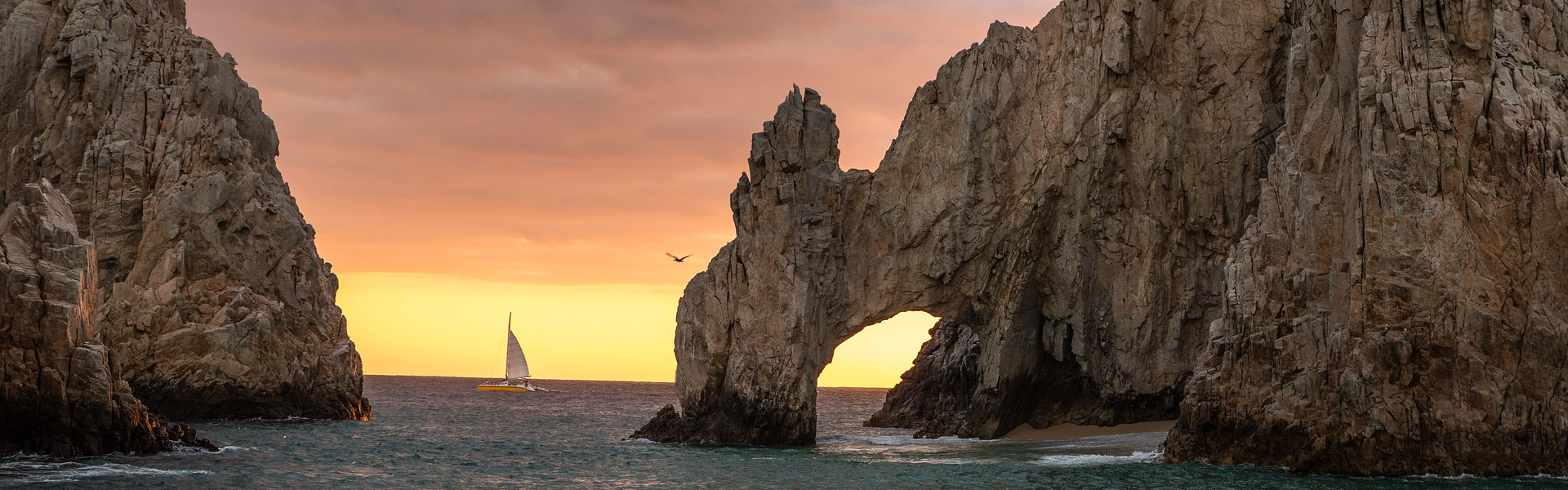
Los Cabos occupies the southern tip of the Baja California peninsula, at the exact point where the Pacific meets the Sea of Cortez. The landscape is nothing like the Caribbean: a desert of cardón cactus running down to granite cliffs, with no jungle, no mangrove and almost no rain. Anyone arriving in search of Cancún has the wrong destination; anyone arriving for something else finds one of the most striking coastlines in Mexico.
The essentials in four lines
- About six hours from Montreal to Los Cabos airport (SJD), seasonally non-stop or with a connection.
- Baja California Sur runs two hours behind Montreal in winter and three in summer.
- No sargassum: the region faces the Pacific and the Sea of Cortez, not the Atlantic.
- Most Pacific-facing beaches are not safe for swimming. The detail matters before booking.
Two towns, one corridor
Cabo San Lucas
At the tip, around a deep marina. This is the lively side: bars, sportfishing boats, cruise tenders, and Médano beach, the only large swimmable beach in town. Water taxis leave from here for the Arch, the pierced rock formation marking the end of the peninsula, and for Lover’s Beach, reachable only by boat.
San José del Cabo
Thirty-two kilometres east, a colonial town on a regular grid, with its square, its eighteenth-century church and a gallery district that holds an art walk on Thursday evenings from November to June. Far quieter, more Mexican, and twenty minutes from the airport.
The corridor
The road linking the two towns runs along the Sea of Cortez and holds most of the large resorts, the golf courses and the sheltered bays. This is where the beaches you actually swim at are found.
The beaches, and which to avoid
It needs saying plainly because few brochures do: on the Pacific side, from Cabo San Lucas northward, shore break and rip currents make swimming dangerous almost year-round. Those beaches are magnificent to look at and to walk, not to enter. Flags and signs are to be taken seriously.
On the Sea of Cortez side, by contrast, three bays offer calm clear water: Chileno and Santa María, both excellent for snorkelling with rocky reef metres from shore, and Palmilla, wider and more family-oriented. Médano beach in Cabo San Lucas remains the most convenient for anyone staying in town.
A word on water temperature: it is cooler than the Caribbean, around 20 to 22 degrees in January and February, rising to near 28 in late summer. Not a trivial point for anyone planning to swim daily in winter.
The whales
From mid-December to mid-April, grey whales complete a ten-thousand-kilometre migration from the Arctic here, and humpbacks come up from the south. Trips leave the marina for two or three hours, and full breaches within tens of metres of the boat are not unusual.
It is probably the best reason to choose Los Cabos over a Caribbean destination for a winter trip.
Fishing, golf and desert
Los Cabos bills itself as the marlin capital of the world, and the autumn tournaments draw entire fleets. A half-day boat trip stays within reach even for a first-timer.
Golf takes the other half of the market, with a dozen championship courses, several by well-known architects and laid out between the cactus and the ocean.
Inland, the Sierra de la Laguna reserve and the village of Todos Santos, an hour north on the Pacific coast, offer a useful contrast: lanes, galleries, mango orchards and a turtle beach where hatchling releases run from October to March.
All-inclusive in Los Cabos
The format has taken firm hold over the past fifteen years, above all along the corridor and at the western edge of San José. You find large family resorts, adults-only properties and a few upper-tier addresses. A significant share of the hotel stock still sells room-only, the region having a genuine restaurant scene.
The point to check first, here more than anywhere, is whether you can swim in front of the hotel: two neighbouring properties can have one a sheltered bay and the other a beach closed to swimming. Our criteria for choosing an all-inclusive hotel put that among the first questions.
When to go
The climate is desert and sunny nearly all year. From November to April, days sit around 26 °C and nights cool sharply: bring a jacket. From May to October the heat builds, the water warms, and the Pacific cyclone season runs June to November with a September peak.
High season matches the North American winter, with price peaks over the holidays and in March. May, June and November offer the best compromise. Our guide on when to travel south from Montreal places those windows in the departure calendar.
To plan this trip, see also our Mexique page, Acapulco, Cancun and Mexico or the Dominican Republic.


