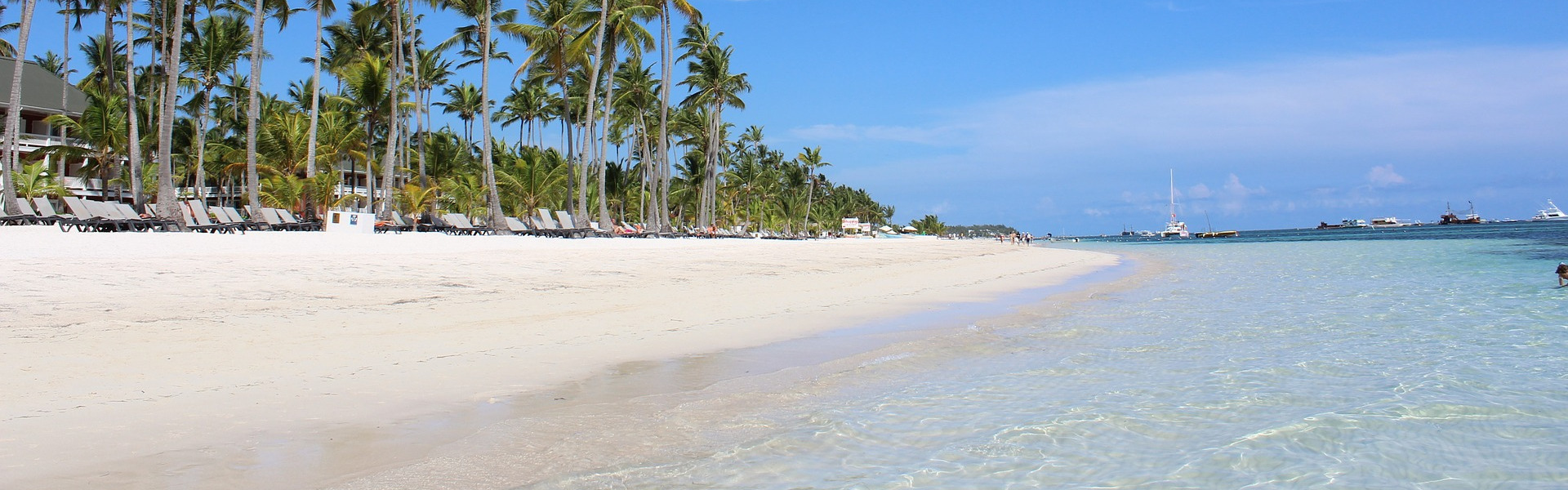
Punta Cana is not a town. It is some fifty kilometres of coast at the eastern tip of the Dominican Republic, where forty years of building have produced the densest concentration of all-inclusive hotels in the Americas. The name works as a commercial label for a run of areas that share neither the same sand, nor the same sea, nor the same clientele. Knowing which one suits you changes the whole stay.
The essentials in four lines
- About four hours non-stop from Montreal to Punta Cana airport (PUJ), the busiest in the Caribbean.
- The tourist card is included in the airfare; an electronic entry form must be completed before departure.
- Dominican peso, with US dollars accepted throughout the hotel zone. Spanish, French and English are spoken in the resorts.
- December to April is the dry season. Hurricane season runs June to November.
Choosing your area
Bávaro
The heart of the destination, and the best choice for a first visit. A barrier reef runs a few hundred metres offshore and breaks the swell: the sea is flat, shallow, without strong current. This is where most of the large family resorts sit, along with the widest beaches and the densest services.
Cabeza de Toro and Punta Cana village
Further south, a quieter and less built-up area, with narrow but peaceful beaches and a lagoon suited to kiteboarding. A good compromise for anyone who wants flat water without the density of Bávaro.
Cap Cana
A private estate south of the airport, with its marina, championship golf courses and Juanillo beach, a white crescent closed off by cliffs. The upper tier of the destination, and the quietest sector.
Uvero Alto and Macao
To the north the reef breaks off: the sea opens up, the waves get real, the sand turns golden. It is not the flat-water postcard, but it is wilder and less built, and Macao remains one of the few public beaches in the area, used by Dominicans and surf schools.
What to do outside the resort
Saona Island, in the Parque Nacional del Este, is the most-sold excursion: catamaran or speedboat, a stop at the Palmilla natural pool where you stand in waist-deep water a kilometre offshore, lunch on the beach. Go early; the groups converge after eleven.
Hoyo Azul, at Cap Cana, is a saturated blue cenote at the foot of a forty-metre cliff, at the end of a twenty-minute path. The Ojos Indígenas ecological park inland protects twelve freshwater lagoons fed by the aquifer and a shaded trail where endemic birds are easy to spot.
Buggy runs through the cane plantations, ziplines and horseback riding on the beach round out the offering. Further afield, Samaná Bay and Los Haitises park take a full day but deliver the most spectacular landscape in the region.
And if you want to see the Dominican Republic rather than the hotel zone, Higüey is forty-five minutes away: a real town, a market, and a 1950s concrete basilica whose thirty-metre arch resembles no other church in the Caribbean.
Golf
Punta Cana has established itself as one of the major Caribbean golf destinations, with half a dozen championship courses by recognised architects, several running directly along the ocean. Golf packages are added to all-inclusive stays and should be booked ahead, especially from January to March.
Sargassum, plainly
The east coast of the Dominican Republic faces the Atlantic and receives the brown seaweed drifting in from West Africa. Episodes generally concentrate between March and September, vary greatly from year to year and week to week, and the large resorts rake the beach every morning.
Two useful habits: check the current picture before booking in our file on sargassum in the Caribbean, and know that the north coast around Puerto Plata, along with the southern coast at La Romana, is generally less affected.
Choosing the right resort
This is where the stay is won or lost, because the choice is enormous and very uneven. A few markers that come up constantly in our clients’ feedback: the width of the beach in front of the hotel, the real walking distance from room to sea on the large estates, the quality of the buffet rather than the number of à la carte restaurants, and the reservation policy for those restaurants.
To set out with the right criteria, see our guidance on choosing an all-inclusive hotel and, if you travel with children, our selection of family all-inclusive resorts from Quebec. And if you are still weighing Mexico, our comparison of Punta Cana or Cancún settles it point by point.
When to go
From December to April the air holds around 29 °C, humidity stays moderate and rain rarely lasts more than an hour. This is the Quebec high season, with the highest rates, particularly during March break and the holidays.
May, June and the first half of December offer the best balance between weather and price. From mid-August to October, heat and humidity climb sharply and the cyclone season peaks. Our guide on when to travel south from Montreal breaks those cycles down week by week.
Practical notes
The Dominican peso is the official currency, but US dollars circulate everywhere in the hotel zone. Pay in pesos outside the resorts: the dollar rate applied is rarely in your favour. Tips are not included in the all-inclusive plan and make a real difference to the staff.
Drink the bottled water provided by the hotel. Hotel-zone taxis charge high fixed fares; agree on the price before getting in. And bear in mind that the Dominican Republic occupies half an island: distances are longer than a map suggests.
To plan this trip, see also our Republique Dominicaine page, Puerto Plata, Samana and Punta Cana or Cancun.


