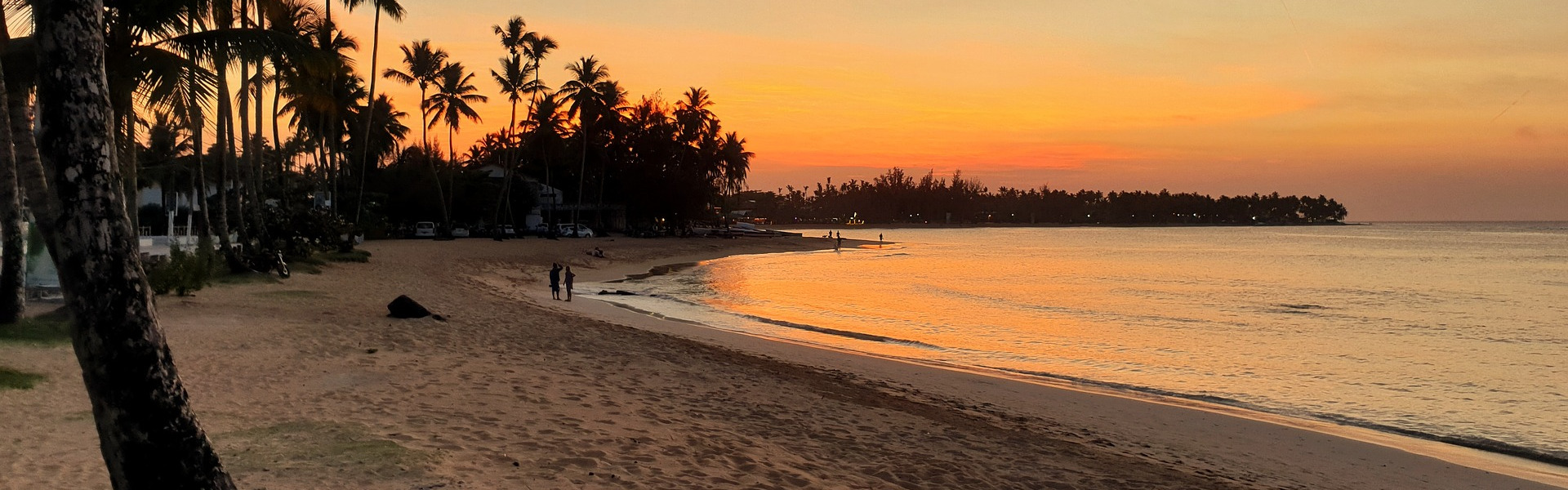
Puerto Plata sits on the north coast of the Dominican Republic, the side facing the Atlantic. The setting differs from the east of the country: an eight-hundred-metre mountain drops almost into the sea, the vegetation stays green year-round, the wind blows harder, and the town existed long before tourism. Columbus had the first European settlement in the Americas established a few kilometres from here.
The essentials in four lines
- About four and a quarter hours non-stop from Montreal to Gregorio Luperón airport (POP), twenty minutes from the hotels.
- The tourist card is included in the airfare; an electronic entry form is completed before departure.
- The north coast is markedly less affected by sargassum than the east coast.
- December to April for the driest weather. Hurricane season runs June to November.
The hotel areas
Playa Dorada
A gated estate gathering some fifteen resorts around a golf course, with a continuous golden-sand beach and a shopping lane at its centre. It is the most practical area: everything is walkable, and the value for money remains among the best in the Caribbean.
Costa Dorada and Maimón
A few kilometres east and west, more isolated and often newer resorts on quieter beaches. Maimón also hosts the Amber Cove cruise port, which livens the area on certain days of the week.
Cofresí
West of town, a steep-sided bay with large family resorts and a marine park where you swim with dolphins and sea lions. A good choice with children, less so for anyone seeking quiet.
The cable car and the mountain
Mount Isabel de Torres, 793 metres, looms over the town. The only cable car in the Caribbean climbs it in ten minutes and opens onto a botanical garden, a view across the whole bay and a Christ the Redeemer statue modelled on the one in Rio.
Go early: the summit clouds over by mid-morning most days, and the queue grows as soon as the excursion buses arrive.
The 27 waterfalls of Damajagua
Forty minutes inland, a river has carved a series of pools and chutes into the limestone. You climb the canyon on foot in a helmet and life jacket, then come back down jumping and sliding from one pool to the next. Depending on water levels and your confidence, you cover seven, twelve or all twenty-seven falls.
It is the most memorable excursion in the region and calls for reasonable fitness. The guides are trained by a local community association that has managed the site since the 2000s.
What remains of the old town
Around Parque Independencia
A hundred or so wooden Victorian houses, trimmed with carpentry lace and painted in strong colours, testify to the tobacco and sugar prosperity of the late nineteenth century. San Felipe fortress, built in 1577, guards the entrance to the bay at the end of the malecón, a seafront promenade several kilometres long that comes alive at the end of the day.
The amber museum
The range behind the town produces Dominican amber, including an exceptionally rare blue variety, and the twenty-million-year-old insect inclusions displayed here inspired a famous film premise. The head office of one of the country’s great rum houses is also in town, and combines easily with the historic centre.
Cabarete and Sosúa, next door
Fifteen minutes east, Sosúa encloses a sheltered bay where the water stays calm and clear, with a reef you can swim to. Twenty minutes further, Cabarete is one of the world capitals of windsurfing and kiteboarding: the thermal wind rises every afternoon with clockwork regularity, and international competitions have been held there since the 1980s.
Both villages work as day trips from Puerto Plata, or as a base for anyone wanting a less resort-driven atmosphere.
Why the north coast rather than the east
Three concrete differences. Sargassum first: the north coast is angled such that it receives far less seaweed than Punta Cana, an advantage that counts from March to September. Price next: at equal category, a stay at Playa Dorada often costs less. And the landscape, greener and more mountainous, with a real town next door rather than a hotel zone.
In exchange, the sea is livelier and less turquoise, and the sand darker. The hotels are on average older, though several have been renovated recently. Our criteria for choosing an all-inclusive hotel and our file on sargassum in the Caribbean will help you decide.
When to go
From December to April the air holds around 28 °C with steady trade winds. The north coast gets slightly more rain than the east of the country, especially in November and December, but the showers are brief.
From January to mid-March, humpback whales gather in Samaná Bay, two and a half hours away by road: one of the few excursions that on its own justifies choosing your dates. Our guide on when to travel south from Montreal sets out the pricing calendar.
To plan this trip, see also our Republique Dominicaine page, Michès, Punta Cana and the sargassum picture.


