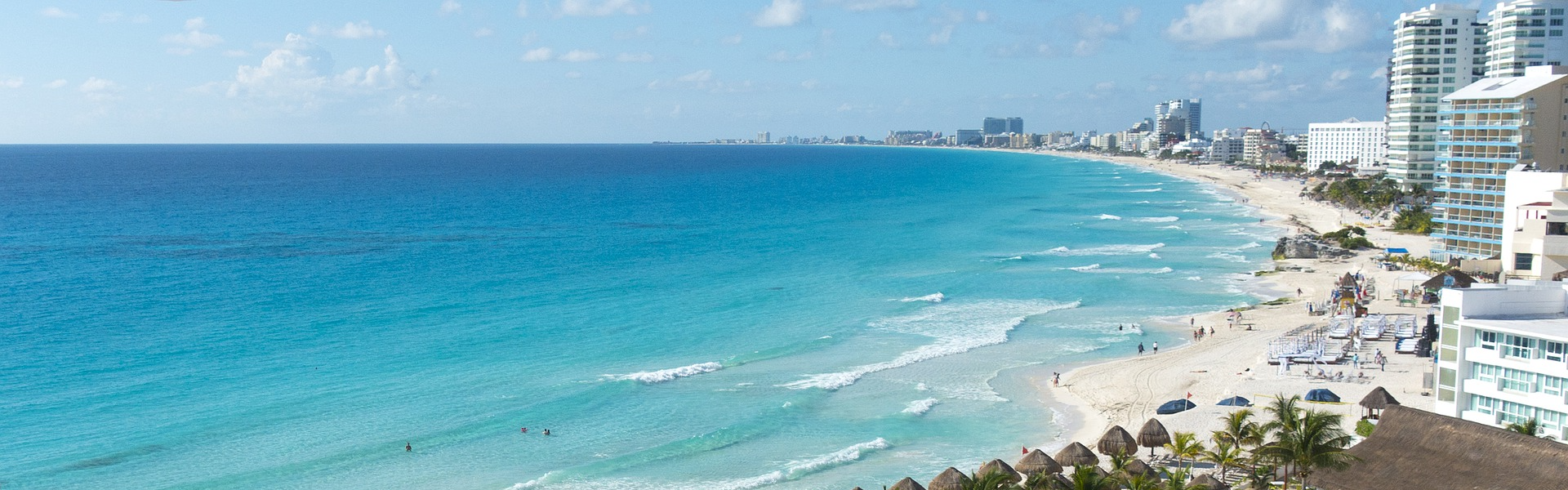
Cancún’s hotel zone is a sandbar twenty-two kilometres long and a few hundred metres wide, wedged between the Nichupté lagoon and the Caribbean Sea. From the air it traces a figure seven. Addresses are given not in streets but in kilometre markers, and that numbering tells you almost everything you need to know before booking.
The essentials in four lines
- About four hours twenty minutes non-stop from Montreal to Cancún airport (CUN), thirty minutes from the hotel zone.
- A valid Canadian passport is required; no visa for a tourist stay. A migration form is filed online or on arrival.
- Quintana Roo stays on Eastern time year-round: same hour as Montreal in winter, one hour behind in summer.
- December to April is the dry season. Hurricane season runs June to November.
Reading the kilometre markers
Kilometre 1 to kilometre 9
This stretch faces the bay of Isla Mujeres, sheltered from open-sea swell. The water is shallow, flat and waveless, which makes it the best sector for young children. The beaches are narrower and the hotels often older and cheaper.
Kilometre 9, the bend
Punta Cancún marks the corner of the seven. It is the heart of the nightlife, with the big clubs, restaurants and shopping centres within walking distance. Convenient if you want to go out without a taxi, loud if you are after quiet.
Kilometre 9 to kilometre 20
Here the beach faces the open sea. The sand is wider and whiter, the water more dramatic, but the slope is steep and the swell is real. This is the sector of the newer large resorts and the upper-tier addresses. Respect the flag system: green, yellow, red, black, posted every morning.
Cancún’s sand is limestone rather than silica: it stays cool underfoot even in full sun. A detail you only notice when you change destinations.
What lies around
Isla Mujeres is twenty minutes by ferry from Puerto Juárez. Playa Norte, at the island’s northern tip, offers calm waist-deep water for tens of metres and ranks among the finest beaches in Mexico. Rent a golf cart and circle the island in half a day.
Between Cancún and Isla Mujeres lies the underwater museum of contemporary art: more than five hundred concrete sculptures submerged between four and eight metres, installed from 2009 onward to draw divers away from the natural reefs and to serve as a substrate for coral. You visit by snorkel, scuba or glass-bottom boat.
From June to September, whale sharks gather off the northern tip of the peninsula. The excursion takes two to three hours of sailing on sometimes choppy water, but swimming beside a twelve-metre fish is an experience apart.
Maya sites and cenotes
Chichén Itzá is two and a half hours away by road, Tulum two hours, Cobá two hours. Go early: at Chichén Itzá, the difference between eight and eleven in the morning is measured in thousands of visitors and ten degrees of heat.
Cenotes, the freshwater sinkholes that pierce the peninsula’s limestone, number in the thousands. Some are developed and busy, others sit at the end of a dirt track. They were sacred to the Maya, who saw them as the entrance to the underworld.
Leaving the hotel zone
Cancún is also a city of nearly a million people, created in 1970 by a government decision on a then-empty coastal bar. El Centro, fifteen minutes away by bus, offers markets, taquerías and the Parque de las Palapas, where families gather in the evening. You eat there for a third of hotel-zone prices, and often better.
Sargassum
The peninsula’s east coast receives the brown seaweed drifting from the south Atlantic, generally from March to October, peaking in May, June and July. Intensity varies greatly from year to year and week to week.
Two useful nuances: the stretch from kilometre 1 to kilometre 9, turned toward the bay, is markedly less exposed than the east-facing side, and the large hotels rake the beach every morning. Check our file on sargassum in Mexico and the Caribbean before fixing your dates.
Cancún or elsewhere
Cancún offers the densest concentration of all-inclusive hotels in Mexico, an airport thirty minutes away, excursions in abundance and a nightlife few destinations match. In exchange, the hotel zone is heavily built up and the atmosphere is resolutely touristic.
If you are weighing the Dominican Republic, our comparison of Punta Cana or Cancún settles it point by point. And to choose the right resort within so vast an offering, see our criteria for choosing an all-inclusive hotel.
When to go
From December to April the air holds around 28 °C, humidity stays low and rain is rare. This is high season, with price peaks over the holidays and March break. May and the first half of June remain excellent and cost markedly less.
From July to October, heat and humidity climb, late-day showers become daily and the cyclone season peaks. Our guide on when to travel south from Montreal sets out those cycles.
To plan this trip, see also our Mexique page, Mazatlán, Playa Mujeres and Mexico or the Dominican Republic.


