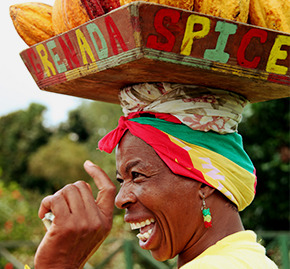
They call it the Spice Isle, and for once the nickname is not an advertising invention: nutmeg appears on the national flag, dries on wooden racks by the roadside and flavours the rum punch handed to you on arrival. Grenada is a volcanic island of 344 square kilometres, green from summit to sea, with the prettiest harbour in the Lesser Antilles and one of the few underwater sculpture parks on earth.
The essentials in four lines
- Canadian passport valid six months beyond your arrival date. No visa for stays of 90 days or less.
- A return or onward ticket and proof of sufficient funds may be required.
- About five and a half hours of flying, with a connection from Montreal. East Caribbean dollar, English spoken.
- January to May is the dry season. Hurricane season runs June to November.
Arriving and getting around
Maurice Bishop International (GND) sits on the southwest tip, ten minutes from Grand Anse and fifteen from St. George’s. From Montreal the connection usually goes through Toronto, which has seasonal service, or through a US airport.
Driving is on the left. The island is small but mountainous: crossing from south to north takes an hour and a quarter on a road that climbs through forest. Local minibuses, loud and cheap, serve the main routes; otherwise a taxi at an agreed fare, or a rental car with the temporary permit issued locally.
Carriacou, to the north, is reached by ferry in ninety minutes or by domestic flight. That island and neighbouring Petite Martinique were hit hard by the hurricane of July 2024 and are still rebuilding: check what services are running before planning a stay.
The beaches
Grand Anse
Three kilometres of pale sand on the southwest coast, looking across at the red roofs of St. George’s at the head of the bay. This is where most of the hotels are, along with an open-air craft market and water that stays calm nearly all year.
Morne Rouge
A shorter, more sheltered cove just south of Grand Anse, separated by a low hill. Fewer people, very calm water, a good choice with small children.
La Sagesse
On the southeast coast, a bay lined with mangrove and coconut palms at the end of a dirt track. Few facilities, one restaurant, and the feeling of having arrived somewhere.
Levera
At the northern tip, a wild beach facing rocky islets. Between April and June leatherback turtles nest here at night; viewing is only with a licensed guide.
The underwater sculpture park
In Molinere Bay, minutes by boat from St. George’s, dozens of concrete figures rest between three and eight metres down. Installed from 2006 onward, they were designed as a substrate for coral: twenty years later the faces vanish under sponges and sea fans, and fish have claimed the territory.
You visit by snorkelling from a boat, or on scuba for the deeper pieces. It was the first park of its kind in the world, and remains one of the most complete.
Experienced divers have another reason to come: the wreck of the Bianca C, a 180-metre liner sunk in 1961 off the south coast, lies between thirty and fifty metres. It is the largest accessible wreck in the Caribbean, for advanced certifications only.
The interior, worth as much as the coast
Grand Etang National Park covers the mountainous centre: a crater lake at 530 metres, rainforest home to mona monkeys brought from Africa three centuries ago, and trails that reach Seven Sisters Falls in an hour of slippery but manageable walking.
At Gouyave on the west coast, the nutmeg processing station still operates as it did in the 1950s: hand sorting, drying on wooden racks, an aroma that catches in the throat. And at River Antoine in the northeast, a rum distillery has run since 1785 on a river-fed waterwheel, with no electricity driving the crusher. The rum it produces is 75 per cent alcohol and cannot travel in the cabin.
Grenada has also made its name in single-origin chocolate. Several workshops process the bean on site, plantation to bar, and welcome visitors with tastings.
All-inclusive in Grenada
The offering is narrower than in Punta Cana or Cancún, and deliberately so. There are two large all-inclusive resorts in the southwest, one couples-only and one open to families, plus a mid-size property owned by the same family for three generations and long cited among the best independent all-inclusives in the Caribbean. Several Grand Anse hotels sell an optional all-inclusive plan added to the room rate.
The maths is worth doing: Grenada has good, affordable restaurants, and part of what makes the island interesting sits precisely outside the resort gate. Our criteria for choosing an all-inclusive hotel help settle it against the way you travel.
When to go
The dry season runs January to May, with air around 29 °C and little rain. From June to December, showers turn daily but brief, and the vegetation takes on an intensity you never see in winter.
Grenada sits at the southern edge of the hurricane belt and statistically receives fewer storms than the northern islands, without escaping them. Two dates are worth building a holiday around: the chocolate festival in May, and Spice Mas, the carnival, in mid-August. To place those windows in Quebec departure pricing, see when to travel south.
Sargassum concerns the Atlantic side, to the east. Grand Anse and the southwest beaches generally stay clear.
Entry requirements, health and safety
A Canadian passport must be valid six months beyond the arrival date. No visa is required up to 90 days, but customs officers may ask for a return ticket and proof of funds. No vaccine is mandatory, except proof of yellow fever vaccination if arriving from an affected country.
Care is provided by the general hospital in St. George’s and a few private clinics, with evacuation to Barbados or Martinique for serious cases. Tap water is treated in urban areas; bottled water remains the safer choice in the countryside.
For current entry conditions and official recommendations, see the Government of Canada page on Grenada.
At the table
The national dish is called oil down: breadfruit, salted meat, callaloo and vegetables simmered in coconut milk until the liquid is fully absorbed, cooked outdoors in a single large pot. It takes hours, it is collective, and it is shared on Saturdays.
On Friday evenings the village of Gouyave holds its fish night: a closed street, grills lit, tuna, conch and crab served on cardboard plates while the music plays. It is one of the few Caribbean gatherings where visitors are firmly in the minority.
To plan this trip, see also Grenade, judging value for money and the All-inclusive vacations section.


