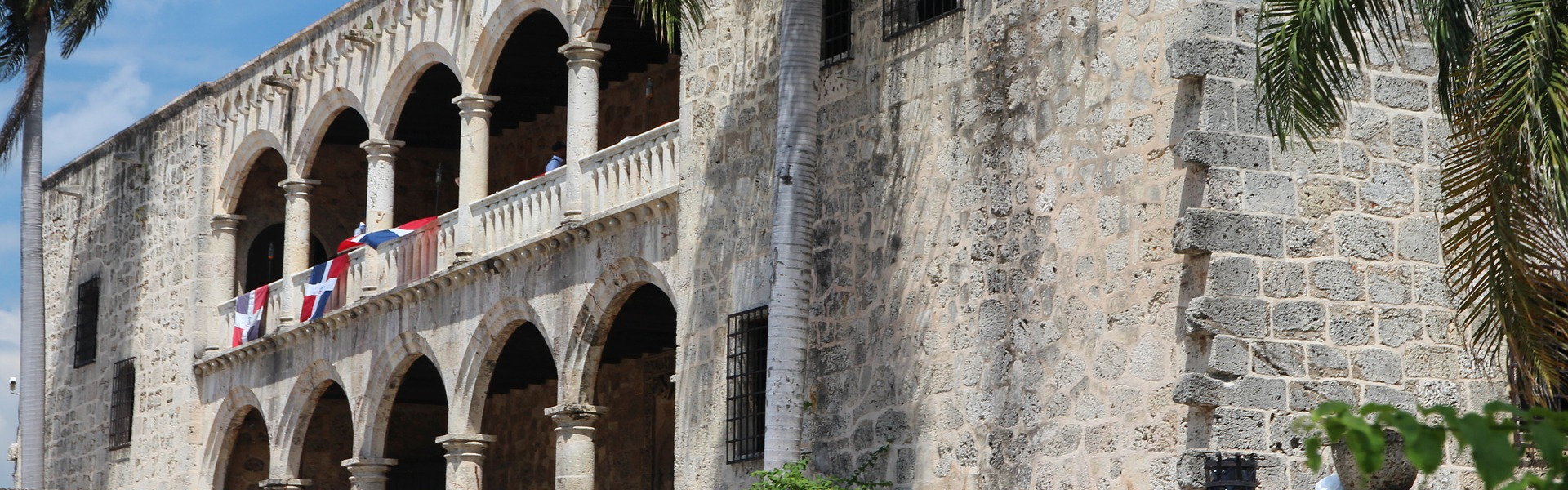
Santo Domingo is the oldest continuously inhabited European city in the Americas. Founded in 1498, it holds the continent’s first cathedral, first university, first hospital and first paved street. Its colonial zone, a UNESCO World Heritage site, fits into a dozen city blocks you can cover on foot in a day. It is also a capital of three million people, loud, musical and alive, four hours by air from Montreal.
The essentials in four lines
- About four hours non-stop from Montreal to Las Américas airport (SDQ), thirty minutes from the colonial zone.
- The Dominican Republic is one hour ahead of Montreal in winter and on the same time in summer.
- This is not a beach city: the nearest beaches are thirty to forty-five minutes east.
- December to April is the dry season. Hurricane season runs June to November.
The colonial zone
Everything begins on Calle Las Damas, the first paved street in the New World, laid out in 1502. It leads to the Ozama fortress, the oldest European military structure in the Americas, whose keep still commands the river mouth.
The primatial cathedral, built between 1512 and 1540, mixes late Gothic and Renaissance in golden coral limestone. A few steps away, the Alcázar de Colón, palace of Diego Columbus, son of Christopher, was built without a single nail; it now houses a museum of sixteenth-century furniture and objects.
Around them, Plaza España, the Museum of the Royal Houses, the ruined monastery of San Francisco and some thirty sixteenth-century buildings form an ensemble of rare density. In the evening the terraces of Calle El Conde and the square come alive, and concerts are held regularly in the monastery ruins.
The rest of the city
The Malecón runs fourteen kilometres along the sea. It is not a beach promenade but a boulevard lined with palms, casinos and hotels, where people walk at sunset and the city gathers at weekends.
Los Tres Ojos, to the east, are three freshwater lagoons at the bottom of limestone collapses, linked by underground passages. The visit takes twenty minutes, with a rope-hauled boat to reach the last one.
The Columbus Lighthouse, a concrete monument shaped like a recumbent cross opened in 1992, projects a beam into the sky on commemorative evenings. The building divides opinion, but the museum inside is worth the visit.
The music
Merengue and bachata were both born in this country and both appear on the UNESCO list of intangible cultural heritage. In Santo Domingo they are not a tourist attraction but the city’s soundtrack: they come out of cars, neighbourhood colmados and terraces at any hour.
On Sunday afternoons, bands play in the open air in the colonial zone and along the Malecón. It is free, it is local, and it is the best way to understand what the music means here.
The beaches, nearby
Santo Domingo has no beach. Boca Chica, thirty minutes east, occupies a bay closed by a reef where the water stays waist-deep for hundreds of metres: it is the capital’s own beach, very busy at weekends. Juan Dolio, forty-five minutes away, is quieter and holds a few resorts.
If your trip is primarily a beach holiday, Punta Cana, La Romana or Puerto Plata remain more logical choices. Santo Domingo combines well as two or three nights before or after a beach week.
At the table
The classic Dominican breakfast is called mangú: mashed green plantain served with pickled onions, egg, fried cheese and salami. At midday, la bandera brings together rice, red beans and meat. Sancocho, a stew of seven meats, is made for occasions.
The colonial zone has a restaurant scene that has advanced a great deal, from street counter to contemporary table. The Mercado Modelo and the neighbourhood colmados give the other side.
Practical notes
Accommodation consists of city hotels, renovated colonial houses and a few characterful addresses in the historic zone. There is no all-inclusive in the capital; you find them at Boca Chica and Juan Dolio.
As in any large city, agree taxi fares in advance and ask about neighbourhoods. Consult the Government of Canada page on the Dominican Republic before departure.
To plan this trip, see also our Republique Dominicaine page, Samana, Sosua and the sargassum picture.


