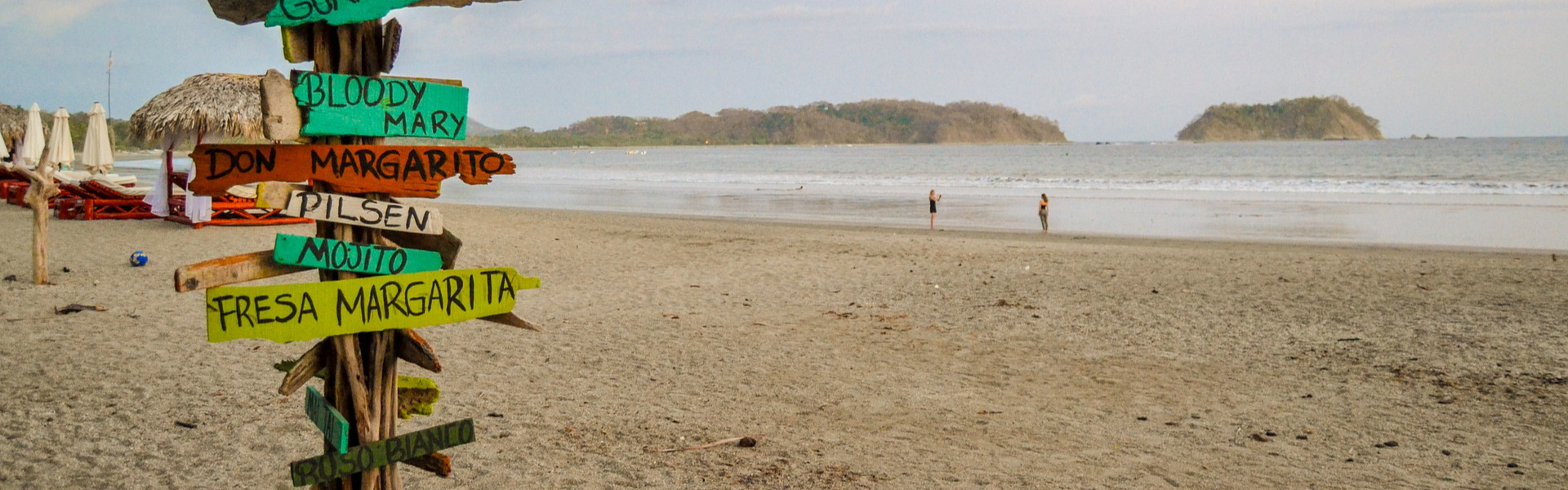
Sámara occupies a horseshoe bay on the Nicoya peninsula, sheltered by a reef running headland to headland. That barrier breaks the Pacific swell and creates one of the few beaches in Costa Rica where you swim without watching the currents. It is what has long made it the family destination of the Pacific coast.
The essentials in four lines
- About five and a half hours non-stop from Montreal to Liberia (LIR), then two and a half hours by road.
- Costa Rica runs one hour behind Montreal in winter and two in summer.
- No sargassum, and calm water thanks to the reef: the best swimming in Guanacaste.
- December to April is the dry season. Green season from May to November.
The bay
The beach runs a little over three kilometres, with golden-grey sand and coconut palms to the water’s edge. The reef, visible at low tide, closes the bay a few hundred metres offshore: inside it the water stays flat and shallow, and children can play without risk of rip currents.
At the eastern end, Chora islet is reached by kayak at low tide or by boat, with a sandy bottom and reef fish. It is the simplest half-day outing from the village.
Five kilometres southeast, Playa Carrillo traces a perfect curve of pale sand lined with palms, with no building on the landward side: the road passes behind and the beach has stayed entirely public. It is one of the most photographed in the country.
The village
Sámara fits into a few streets, only one of them paved. It has sodas, a few beachfront restaurants, surf schools for beginners, Spanish schools and a dive shop. The pace is slow, prices reasonable, and the proportion of Costa Rican families on holiday stays high, which is not the case everywhere on this coast.
The bay wave is gentle and suits a first lesson well; experienced surfers head instead to Playa Barrigona or toward Nosara, to the north.
Around
The Werner Sauter reserve, on the hill east of the village, protects a dry forest where you meet howler monkeys, coatis and abundant birdlife; two hours of trails.
Barra Honda national park, two hours away, protects a network of limestone caverns sixty million years old, some of which are descended with equipment and a guide. Further north, Nosara and Ostional host the arribadas, the mass nestings of olive ridley turtles that gather tens of thousands of animals over a few nights, mainly from July to December.
Accommodation
There is no large all-inclusive resort at Sámara. The supply consists of small hotels, cabinas, rentals and a handful of more polished addresses on the hillsides, nearly all sold without meals.
That fits the place: the village has enough restaurants to eat differently every evening at reasonable cost. If you want an all-inclusive plan, the large Guanacaste resorts are two and a half hours north; our criteria for choosing an all-inclusive hotel help compare the two approaches.
A word about the roads
The Nicoya peninsula is crossed on roads partly still gravel, with fords in the rainy season. The drive from Liberia takes two and a half hours and feels longer than the distance suggests. A high-clearance vehicle is advisable if you plan to explore neighbouring beaches on your own.
When to go
From December to April the sky stays clear and the air holds around 32 °C. It is high season, but Sámara remains markedly quieter than Tamarindo.
From May to November, late-day showers green the peninsula again and prices fall noticeably. September and October are the wettest months and some businesses close. Our guide on when to travel south from Montreal sets out the pricing calendar.
To plan this trip, see also our Costa Rica page, Playa Tambor, Puntarenas and judging value for money.


