Ireland Travel from Canada: The Complete Guide
Ireland is one of the easiest European countries to reach from Canada: Air Canada flies nonstop from Montréal to Dublin in about 6 hours, and four airlines connect Toronto to Dublin nonstop in roughly 6.5 to 7 hours. Canadian citizens can stay up to 90 days without a visa, and since Ireland sits outside the Schengen area, the EES and ETIAS systems do not apply there. The best months run from May to September, when daylight stretches up to 17 hours and temperatures hover between 15 and 20 °C. The island suits a driving loop: Dublin, Kerry, Connemara and the Antrim coast fit into a 10-to-14-day itinerary. As a guideline, budget 2,500 to 4,000 Canadian dollars per person for a week, flight included.
The essentials at a glance
| Question | Answer |
|---|
| Flight from Canada | Nonstop from Montréal (about 6 h, Air Canada) and Toronto (6.5 to 7 h, four airlines) |
| Visa for Canadians | None for stays of 90 days or less; UK ETA required for Northern Ireland |
| Time difference | 5 hours ahead of Montréal and Toronto (briefly 4 hours around clock changes) |
| Currency | Euro (€); 1 € is worth about 1.60 Canadian dollars. Pound sterling in Northern Ireland |
| Language | English and Irish (Gaeilge); English is spoken everywhere |
| Best time to go | May to September; May, June and September offer the best weather-to-crowds ratio |
| Driving | On the left; speeds in km/h (mph in Northern Ireland); book an automatic early |
| Electricity | 230 V, type G plugs; adapter required |
Why Ireland
Ireland packs a remarkable amount of scenery into a small island. It measures about 450 km north to south: in a single day's drive you can go from the Cliffs of Moher to the fjord country of Connemara, stopping in a fishing village for seafood chowder along the way. The Montréal-Dublin flight is actually shorter than Montréal-Paris, which matters for a first trip to Europe with kids or for a one-week getaway.
The Irish pub remains a social institution first and a bar second. In Galway, Dingle or Doolin, traditional music sessions start around 9:30 pm and nobody blinks if you order a tea. Irish food has come a long way too: homemade brown bread, Kerry lamb, Galway Bay oysters and a surprising restaurant scene in small towns like Kinsale and Dingle.
History is written across the landscape. Newgrange, a passage tomb roughly 5,200 years old, predates the Egyptian pyramids; the monastic sites of Glendalough and Clonmacnoise tell the story of the island's early Christian golden age; and the famine-era emigration to North America resonates with many Canadian visitors whose ancestors crossed the Atlantic from these shores. Everything is easy to visit in English, with a warmth of welcome that lives up to its reputation.
When to go
| Period | Climate and atmosphere | Verdict |
|---|
| December to February | 4 to 8 °C, short days (8 hours of light), firelit pubs, Christmas markets in Dublin and Galway | Low season and gentle prices; good for a city break |
| March to April | 8 to 12 °C, daffodils and spring lambs, St. Patrick's Day parade in Dublin on March 17 | Good period; book early around March 17 |
| May to June | 12 to 18 °C, very long days, coastal roads still quiet | Excellent choice, the best balance of the year |
| July to August | 15 to 20 °C, festivals everywhere, peak season in Kerry and Galway | Very pleasant, but book months ahead |
| September | 13 to 17 °C, warmest sea of the year, thinning crowds, beautiful light on the west coast | Excellent choice for the Wild Atlantic Way |
| October to November | 8 to 13 °C, more frequent rain, first Atlantic storms | Fine for cities, less so for the coast |
How to get there from Canada
From Montréal, Air Canada operates a nonstop Boeing 787 service to Dublin about four times a week in high season, departing in the evening around 8:50 pm and landing the next morning after roughly 6 hours in the air. Check operating days by season: outside the peak months, a connection may be needed. From Toronto, the choice is wider: Air Canada, Aer Lingus, Air Transat and WestJet all fly nonstop daily, with flight times of 6.5 to 7 hours eastbound and about 7 to 7.5 hours coming home.
Starting 10 June 2027, Air Canada adds a seasonal nonstop between Toronto and Shannon, which brings the Cliffs of Moher, the Burren and the southern stretch of the Wild Atlantic Way much closer. From Québec that routing means a connection in Toronto: the nonstop from Montréal remains the Dublin service. Schedules subject to change by the carrier.
Connecting options run through Toronto, London and other European hubs. Dublin Airport sits about 10 km north of the city centre, linked by express coaches in around 30 minutes. From Dublin, Belfast is about 2 hours away by road or rail, while Galway and Cork are 2.5 to 3 hours by car or train, which makes the capital a practical starting point for any loop of the island.
Ireland's essential regions
Dublin and its surroundings
The capital deserves two or three days: the Book of Kells at Trinity College, the Guinness Storehouse, Kilmainham Gaol and the Georgian squares are all walkable. The DART commuter train reaches the cliff path at Howth in 30 minutes. Our complete guide to Dublin covers neighbourhoods, day trips and budgets.
Kerry and its peninsulas
The Ring of Kerry, a 179 km loop around the Iveragh Peninsula, strings together mountains, lakes and brightly painted villages, with Killarney and its national park as the natural base. The more compact Dingle Peninsula wins hearts with the Slea Head drive and pubs where traditional music plays nightly.
Galway, Connemara and the Cliffs of Moher
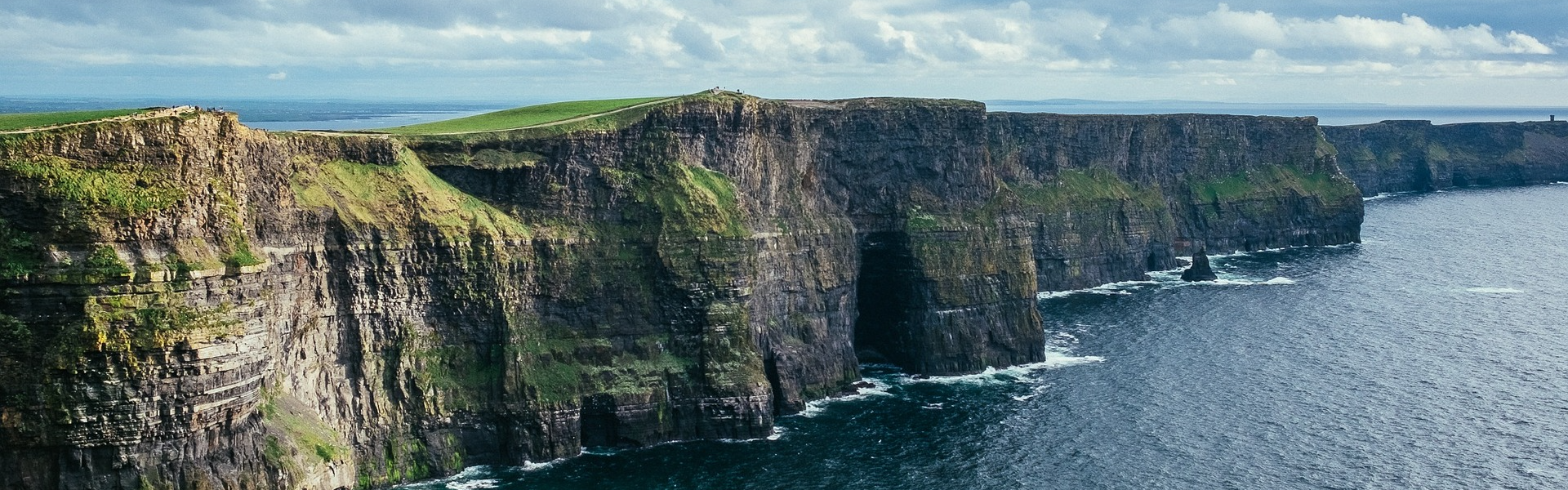
Galway, a university town with music on every corner, is the gateway to Connemara, its bogs and Kylemore Abbey. Under two hours south, the Cliffs of Moher drop 214 m into the Atlantic; an 8 km path runs along the top between Doolin and Hags Head. The lunar limestone landscape of the Burren rounds out the day.
Cork and the south
The Republic's second city revolves around the English Market, a food hall trading since 1788. Nearby sit Blarney Castle and its famous stone, the port of Cobh, the Titanic's last call in 1912, and Kinsale, a small gourmet harbour town with multicoloured facades.
The Ancient East
Between Dublin and the southeast lie the island's great historic sites: Newgrange and the Boyne Valley, the monastic settlement of Glendalough in the Wicklow Mountains, medieval Kilkenny and the Rock of Cashel. Short distances mean you can cover it all in two or three days from Dublin.
Belfast and the Antrim coast
Up north, Belfast and the Giant's Causeway justify adding two days to the loop, UK ETA in hand. Titanic Belfast, the murals of the city's west side and the 40,000 basalt columns of the Antrim coast pair naturally with Dublin. Our Belfast guide covers the entry rules specific to Northern Ireland.
The budget, in Canadian dollars
| Item | Budget | Comfort | High end |
|---|
| Round-trip flight from Canada | $700 to $1,000 | $950 to $1,400 | $2,500 and up (business class) |
| Accommodation (per night, 2 people) | $120 to $180 | $200 to $320 | $400 and up |
| Meals (per day, per person) | $40 to $60 | $70 to $110 | $150 and up |
| Local transport (per day) | $10 to $25 (bus, train) | $60 to $90 (rental car, fuel) | $150 and up (private driver) |
| Activities and sightseeing (per day) | $0 to $25 | $40 to $70 | $120 and up |
These ranges are provided as a guideline, based on rates and prices observed in 2025-2026. They vary with the season, the exchange rate and how far ahead you book. A week in Ireland generally comes to 2,500 to 4,000 Canadian dollars per person, flight included, at a mid-range level with a rental car.
Entry requirements and health for Canadian citizens
- Visa: none required for Canadian citizens staying 90 days or less, for tourism or business.
- Passport: must be valid for at least the expected duration of your stay in Ireland, per travel.gc.ca.
- EES and ETIAS: Ireland is outside the Schengen area, so these systems do not apply there. If your itinerary includes a Schengen country, EES (photo and fingerprints on first entry, in force since October 2025) will apply to that leg, and ETIAS is expected in late 2026: check travel.gc.ca before departure.
- Northern Ireland: Belfast and the Giant's Causeway are in the United Kingdom; Canadians need a UK Electronic Travel Authorisation (about 20 pounds, valid 2 years) before entering, even by road from the Republic.
- Official advisory: the Government of Canada advises taking normal security precautions in Ireland, its lowest level.
- Health: keep routine vaccinations up to date; travel.gc.ca also suggests hepatitis B. Nothing is required for entry.
- Travel insurance: strongly recommended; non-residents pay for hospital care and provincial health plans cover only a fraction of costs abroad.
- Money: cards and contactless payment are accepted almost everywhere; keep some cash for markets and rural areas.
One last tip: a first visit works best when limited to half the island. Plan 7 nights for Dublin and the southwest, or 10 to 14 nights for a full loop including Connemara and Northern Ireland. Ireland also pairs well with Scotland or London, both under 90 minutes by air from Dublin.
Ready to drive the Ring of Kerry or catch a trad session in a Galway pub? The advisors at Voyages AquaTerra build your custom itinerary. 450-628-6241 | 1-866-628-6241 | info@voyagesaquaterra.com
Voyages AquaTerra is a licensed travel agency in Québec.