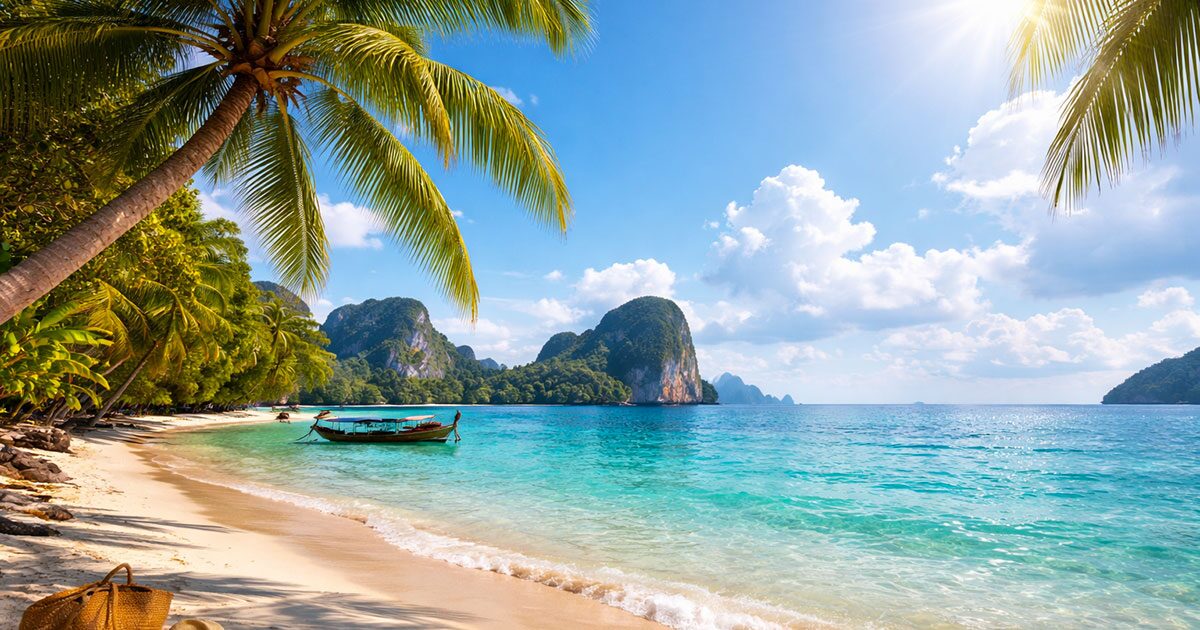




All-inclusive travel from Quebec: the complete guide to the South
Eleven sun destinations are reached nonstop from Montreal, and six from Quebec City. None requires a visa of a Canadian citizen. Only one asks for a passport valid six months beyond your return, contrary to what almost every article repeats. This guide tells you which ones fly nonstop, what has to be settled before you book, and which month to avoid depending on where you are going.
A week in the South is the Quebec reflex, and that is exactly why it gets prepared badly. People book fast, look at the price, and go. Then they find out on arrival that the beach is buried in seaweed, that the month they chose is the wettest of the year in that specific spot, or that a mandatory form was never filled in.
None of that is hard to avoid. You simply have to know what to look at.
Which sun destinations fly nonstop from Quebec?
Eleven from Montreal-Trudeau, four of them in the winter season only, and six from Quebec City Jean-Lesage. The difference matters more than it appears: a four-hour nonstop and a routing with a connection in Toronto do not give you the same first day of holiday.
| Destination | From Montreal | Flight time | Period |
|---|---|---|---|
| Punta Cana, Dominican Republic | The most heavily served route | About 4 h 30 | Year-round |
| Cancún, Mexico | High frequency | About 4 h 15 | Year-round |
| Puerto Plata, Dominican Republic | Now year-round | About 4 h 15 | Year-round |
| Samaná, Dominican Republic | Now year-round | About 4 h 20 | Year-round |
| Montego Bay, Jamaica | Regular service | About 4 h | Year-round |
| San José, Costa Rica | Regular service | About 5 h 15 | Year-round |
| Nassau, Bahamas | Low frequency | About 3 h 15 | Seasonal |
| Liberia, Costa Rica | Low frequency | About 5 h 15 | Seasonal |
| Puerto Vallarta, Mexico | Winter service | About 5 h 30 | Winter only |
| Aruba | New on Air Transat, one flight a week | About 5 h 30 | From 12 December 2026 |
| Barbados | New on Air Transat, two flights a week | About 5 h 30 | From 13 December 2026 |
| Los Cabos, Mexico | New on Air Transat, one flight a week | About 6 h | From 10 December 2026 |
What leaves from Quebec City
Flying from Quebec City saves the round trip to Montreal, and the airport takes minutes to cross. The network is shorter, and it has widened for the 2026-2027 winter.
- Cancún, raised to eight flights a week on Air Transat, with Air Canada and WestJet also serving it.
- Punta Cana, served by the same three carriers.
- San José, Costa Rica, new, starting 15 December 2026, one flight a week.
- Fort-de-France, Martinique, raised to two flights a week.
- Pointe-à-Pitre, Guadeloupe, inaugurated in February 2026.
- Fort Lauderdale, three flights a week from 15 November 2026.
Martinique and Guadeloupe are worth a pause. They are the French Antilles, with no language barrier for a French speaker, reached nonstop from Quebec City. Few travellers here think of them, because they are not classic all-inclusive destinations, and that is exactly what makes them interesting to anyone who has done Punta Cana three times.
Departures also exist from Bagotville depending on the season. The schedules published online for that airport were out of date at the time of writing, so have the real routes confirmed by your adviser rather than by the airport site.
Is Cuba still an option this winter?
No, and it is worth saying plainly, because out-of-date packages are still circulating online.
Air Canada suspended its Cuban routes in February 2026 over an aviation fuel shortage affecting nine of the country's airports. Air Transat, Sunwing Vacations, WestJet Vacations and WestJet Vacations Quebec followed in June, all for an indefinite period. The restart that had been announced for 1 November was cancelled.
The hotel picture followed the same curve. Meliá left the island entirely in July 2026, thirty-four properties at once. Iberostar and Royalton had already withdrawn. Tourist arrivals fell forty-eight percent in the first quarter of 2026.
If you see a Cuba package advertised anywhere this winter, have it validated before paying for anything.
Do you need a visa, and which passport?
None of these destinations requires a visa of a Canadian citizen for a tourist stay. The real question lies elsewhere: passport validity, and the online form to complete before departure.
The six-month validity rule that nearly every article repeats is wrong for six destinations out of seven. Here is the actual state of things.
| Destination | Permitted stay | Passport validity | Form before departure |
|---|---|---|---|
| Mexico | Up to 180 days | The duration of your stay | None. The entry stamp is electronic. |
| Dominican Republic | 30 days, extendable | Duration of stay until 31 December 2026 | E-Ticket, free, on entry and on exit |
| Jamaica | 90 days | The duration of your stay | Electronic C5 declaration, free |
| Costa Rica | 180 days | The duration of your stay | None. Return ticket and proof of funds required. |
| Aruba | 90 days out of 180 | The duration of your stay | ED card required, infants included, with a sustainability fee |
| Barbados | Up to 180 days | The duration of your stay | Online form, opens 72 hours before arrival |
| Bahamas | Up to 8 months | 6 months beyond your return | None. Paper card completed on arrival. |
Four things to take from that table.
- The Bahamas are the only exception to the six-month rule. Everywhere else a passport valid for the duration of the stay is enough. Aim for a margin anyway: an unplanned stopover in a third country can be stricter.
- The Dominican flexibility expires on 31 December 2026. After that date the six-month rule may return. If you are travelling in January, have it rechecked.
- Mexico no longer has a form to complete before departure. The paper card was abolished for air arrivals. Sites selling you a Mexican tourist card to fill in beforehand are selling something that no longer exists.
- Four destinations do require an online form, and it is free in all four cases. Always go through the country's official portal. Intermediaries charge for a form that takes five minutes and costs nothing.
On health, no vaccination is required to enter any of these destinations. What few articles are currently flagging: an active measles advisory covers the Dominican Republic, Jamaica, Costa Rica, Aruba and Barbados. Costa Rica additionally carries a chikungunya advisory, and Barbados one for Oropouche virus. A travel clinic consultation six to eight weeks before departure settles all of it, and it is the moment to confirm your measles vaccination is current.
Our article on embassies and travel insurance goes through what to check in a policy before leaving.
When should you go, and which month should you avoid?
The answer depends on the destination, and two of them run on a calendar that is the reverse of what people assume.
Across the Caribbean generally, the dry season runs from December to April, and September and October are the wettest months. But two exceptions change an itinerary completely.
The Dominican Republic has three climates, not one
Punta Cana, on the east coast, follows the expected calendar: dry from February to April, wet from late April to October.
Puerto Plata, on the north coast, works in reverse. Its driest months are June to September, and its wettest are November and December, when the northeast trade winds hit the mountains. Puerto Plata receives forty percent more rain over a year than Punta Cana.
Samaná has no dry season at all and receives double what Punta Cana does. You go there for the humpback whales from January to March, rather than for guaranteed sun.
The practical consequence: "December in the Dominican Republic" is not advice. It is excellent in Punta Cana and it is the worst month of the year in Puerto Plata.
Costa Rica has two coasts and two opposite regimes
The Costa Rican national meteorological institute is explicit: the Caribbean slope has no defined dry season. Puerto Limón receives more rain in January, in the middle of the national dry season, than it does in September. Its best windows are February-March and September-October, which is exactly the worst period on the Pacific side.
On the Pacific, Guanacaste is the driest region in the country: January sees almost no rain at all, October sees ten times more.
The month to avoid, destination by destination
- Cancún and the Riviera Maya: September, which stacks the rainfall peak, the hurricane peak and a heavy residue of sargassum.
- Punta Cana: September and October.
- Puerto Plata: November and December.
- Jamaica: September and October. Rain there follows a twin-peak pattern, in May and October.
- Costa Rica, Pacific side: October. Caribbean side: December and July.
- Bahamas: September.
- Barbados: October and November.
- Aruba: no genuinely bad month. November is the wettest and stays very dry.
One detail articles almost always leave out: in Los Cabos the sea drops to twenty-two degrees in February and March, and nights fall to fifteen. In midwinter it is a golf and desert destination rather than a swimming one. The same applies to Nassau, where cold air masses off the continent occasionally push the thermometer below ten.
Our month-by-month calendar covers each period, with relative pricing and crowds.
Hurricanes: what should you actually worry about this winter?
The Atlantic season runs from 1 June to 30 November, with a statistical peak on 10 September. A trip between January and April falls outside it entirely.
For the winter ahead there is a nuance nobody is publishing, and it reverses the usual advice. El Niño is strong this year, and it inverts the two ocean basins. NOAA forecasts a seventy-five percent probability of a below-normal Atlantic season, and a seventy percent probability of an above-normal Pacific season.
In other words, recommending Mexico's Pacific coast this year to avoid hurricanes means recommending exactly the wrong coast. The East Pacific also opens its season two weeks earlier than the Atlantic, on 15 May.
Two clarifications about destinations that get described badly. Aruba is presented as outside the hurricane belt: its own weather service describes it as on the southern fringe, with considerable damage roughly once a century but tropical storms making landfall several times a decade. And Barbados is routinely described as too far south to be hit, when it is the first land the belt meets coming from the east, and it took a category 4 in July 2024.
Sargassum: how do you know whether your beach will be clear?
A list of sargassum-free beaches is out of date before it is published, because a beach changes within days depending on the wind. What stays true is the principle and the tool.
The principle is orientation. Sargassum arrives from the east, pushed by the trade winds. Windward coasts receive it; leeward coasts and sheltered bays are largely spared. That is why Punta Cana gets it and Puerto Plata gets much less, why Aruba's resort beaches stay clear while its windward coasts do receive it, and why the west coast of Barbados is calm when its east coast is not.
Puerto Vallarta and Los Cabos have none at all, and it is not luck. The phenomenon belongs to the Atlantic basin. The Pacific coast is in a different ocean, with no hydrographic connection to the sargassum belt. For the full picture, see our 2026 sargassum guide.
The calendar. The belt forms in January and February, reaches its maximum extent in June, drives the Caribbean beaching peak in June and July, then declines until November. December to March is the quietest window.
One reasoning trap worth knowing: the quantity at sea and the quantity on the beach do not move together. 2026 is lighter than 2025 across the Atlantic, and yet Quintana Roo passed its 2025 record before the end of August. It all depends on trajectory and wind. You cannot infer the state of one beach from the basin total.
For Mexico, the only genuinely useful tool is the Quintana Roo monitoring network, which publishes beach-by-beach status continuously. Ask your adviser for it the week you leave.
What does a trip to the South cost?
We publish no figures. They move with the season, the exchange rate, the hotel category and the booking date, and a range written today will be wrong in two months. Here instead is how the destinations compare with one another, which holds up from year to year.
| Destination | Relative package cost | What drives it |
|---|---|---|
| Dominican Republic | The most affordable | Enormous room inventory and strong competition between operators |
| Mexico, Cancún and Riviera Maya | Affordable to high, very elastic | The gap between a good four-star and a five-star is wider here than anywhere else |
| Jamaica | High | A more upscale hotel stock, a lot of adults-only |
| Bahamas | High | Island cost of living and proximity to the American market |
| Barbados | High | Few all-inclusive packages, more independent hotels |
| Aruba | High | A small island, limited supply, steady year-round demand |
| Costa Rica | High, and a different formula | All-inclusive is marginal there: you pay for excursions, transfers and lodges |
Costa Rica deserves a warning. It appears in sun-destination rankings, but it is not an all-inclusive country. You go for the volcanoes, the forest and the wildlife, with travel and activities paid separately. A traveller who wants a week on a beach without thinking will be disappointed, and a traveller who wants something other than a beach will get their money's worth.
How to judge real value for money and ten ways to pay less without sacrificing the trip.
What does an all-inclusive package actually cover?
The phrase is reassuring, which is exactly why the detail behind it matters. Two hotels both advertising all-inclusive can deliver very different weeks.
Almost always included: the return flight from your departure city, airport transfers, lodging, buffet meals, local-brand alcoholic and soft drinks, pool and beach access, non-motorized activities and the evening shows.
What varies from hotel to hotel: how many à la carte restaurants there are and whether they are unlimited or rationed, imported spirits, room service, in-room wifi, motorized water sports, access to the spa facilities as distinct from the treatments themselves, and whether beach chairs can be reserved or are first come first served.
Never included: travel insurance, excursions outside the hotel, spa treatments, seat selection on the flight, extra baggage and tips.
The line to have spelled out before signing is the à la carte restaurants. A package advertising five of them but allowing two a week, with reservations opening at seven in the morning on your first day, does not deliver what the brochure implies.
Travel insurance is never in the package
The Régie de l'assurance maladie du Québec covers very little abroad. A few days in hospital exceeds what most households can absorb, and a medical repatriation runs into tens of thousands of dollars. What you want is emergency medical coverage with repatriation and a 24-hour assistance line, taken out when you book rather than the night before you leave, because cancellation protection starts at purchase.
Montreal, Quebec City, or a regional airport?
Montreal offers the widest choice of destinations, dates and carriers, and competition works on the fares. Quebec City offers an airport you cross in minutes, simpler parking, and six nonstop sun destinations, two of them French Antilles that Montreal does not serve the same way.
The honest calculation includes everything: the drive to the airport, parking for the length of the stay, and sometimes a hotel night before an early departure. A slightly dearer package out of Quebec City sometimes costs a family from Saguenay less than a Montreal one.
How an AquaTerra adviser prepares your trip
The South looks simple to book, and it is, right up until something moves. A flight brought forward six hours, a hotel under renovation that does not advertise it, a beach covered in seaweed the week you arrive, an entry form nobody mentioned.
- Our advisers know the hotels from the inside and know which ones deliver this year, which is not the same as last year.
- They compare the Quebec tour operators against your actual itinerary rather than against a headline fare.
- They check the country's formalities at the time you leave, not at the time an article was written.
- When a flight is cancelled at three in the morning, you speak to a person rather than a form.
- None of this costs more than booking it yourself.
Talk to an AquaTerra adviser at 1 866 628-6241. Tell us the period, the number of travellers and the kind of stay you want, and we build the rest.
See also our all-inclusive packages, our last-minute deals and our family trips.
The other guides in this section
Ten more articles sit alongside this one: which sun destination to choose this winter, the month-by-month calendar, how to choose your hotel, Mexico or the Dominican Republic, Punta Cana or Cancún, resorts for families, paying less without sacrificing the trip, judging real value for money, travelling south to recover and what has changed in travel to the South this year.
Voyages AquaTerra holds a Quebec travel agency licence. Booking through an agency licensed in Quebec gives access to the Fonds d'indemnisation des clients des agents de voyages (FICAV), which covers certain specific situations; the conditions are set out on opc.gouv.qc.ca. Air services, entry formalities, health advisories and seasonal forecasts cited here were verified on 4 September 2026 and change regularly: have your adviser revalidate them before booking, and consult voyage.gc.ca before you leave.


